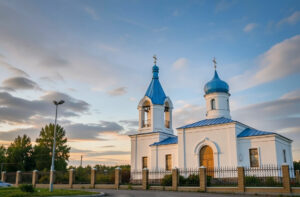
Oboyan is a city that most Russians have not heard of. Kursk region, thirty thousand inhabitants, quiet streets. But there is one point to which the eye is unwittingly drawn — a red-brick hromada on the former shopping square, crowned with twelve cupolas and a dome, which is visible from anywhere in the city.
We built it long and solid. The wooden church that has stood on this site since the middle of XVIII
By the end of the XIX century, it could no longer cope with the influx of parishioners. The decision matured gradually, the money was collected by the whole city — the merchant of the first guild Ryabinin also helped. It took eight years to lay, finish and gild. In December 1898, three days in a row consecrated the chapels: first the southern — the Nativity of the Virgin, then the northern — Nicholas the Wonderworker and, finally, the main — the Holy Trinity. Iconostases shone with gold, the vaults were decorated with painting — the temple turned out the way they wanted to see it.
The twentieth century came without warning. Soviet decrees reached Oboyan in 1922: ninety-nine objects were taken out of the cathedral — crosses, vessels, censers, robes from sixty-one icons. The parishioners traded for every thing. There was little to save: three images – the Savior, the Virgin and Nicholas the Wonderworker – were bought for silver scrap. The rest is gone forever.
Then the war started. By 1941, the cathedral was no longer functioning, but the German offensive and the chaos of the first months of the war suddenly gave the community the opportunity to return. Divine services resumed in December of the same year in a city where everything hung by a thread. Later, the events of the Battle of Kursk unfolded near Oboyan, and people went to the temple as they go only when they are really afraid.
The post-war threat was more prosaic, but no less real. In 1950, the district authorities proposed to convert the cathedral into a granary. For the interior decoration, this meant a slow death — dampness, dust, complete desolation. Bishop Nestor made a retreat: the churches in two neighboring villages were given for storage. The Trinity Cathedral survived.
The cathedral outside is a clash of two architectural styles. Kokoshniks, bizarre silhouette, elegance — all this is from the pseudo-Russian style. High arched openings, semi-columns, heavy monumentality — from Byzantine. The twelve-sided light drum is topped with a two-tiered dome – this solution is rare in provincial temples of that era.
Asymmetry — the apse on the east side, a chapel with a bell tower on the west — does not spoil, but animates the general appearance.
Inside, the space is unexpectedly spacious. Three chapels, high vaults, gilded iconostases — the eye has nothing to catch. On holidays here gathered up to three and a half thousand people. The figure is considerable even by the standards of cities much larger than Oboyan.
The cathedral has not become a monument of architecture in the museum sense — it continues to work. Services
Come, parishioners come. That’s why it was built – not for tourists, not for postcards, but for people who need a place to stop and be silent.
Charity FundHoly Land.
Russian Temples and Monasteries