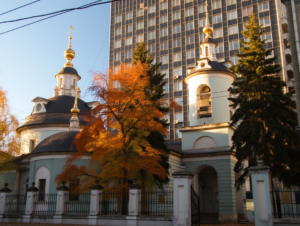
Above the quiet streets of Tara rises a hromada, which you do not expect to see in the heart of Siberia. The forty-meter stone giant plays with semi-columns and “flammable” casings as if it was transported here straight from Solikamsk or Tobolsk. This Spassky Cathedral is the firstborn of stone architecture in the modern Omsk region and, without exaggeration, the main keeper of time in the city.
The grandiose plan began to be implemented in 1753 on the donations of parishioners. The local large-sized brick lay in the walls of monstrous thickness: almost human height on the first floor and a little less on the second. Everything here was done with the expectation of a harsh climate. In 1760, the lower, warm Savior Church with heavy vaults was consecrated — in winter it breathed easily even in severe frosts. Sixteen years later, a cold summer church was raised in the name of the prophet Elijah, where a wide staircase led, and at the level of the second floor there was a balcony, now lost. Tobolsk masters built a classic “ship”, stretched along the east-west axis: an altar apse, a four-piece, a spacious refectory and a porch with an octagonal bell tower.
The exterior of the cathedral is pure Siberian baroque, elegant and daring. The facades are dissected with angular shoulder blades, and the casings of the first floor are completed with tense arc pediments — those very «flammable» ears from which it is difficult to look away. Lecal brick jewelry draws profile visors on the columns, intercepted by “melons”, a detail inherited from the ancient Russian pattern. The temple is crowned by an octagonal dome with a light flashlight, which carries a bulbous head on its high neck. Once the ensemble was surrounded by an openwork metal fence on stone pillars — barbarously dismantled in the Soviet years and restored only to the 400th anniversary of Tara.
The fate of the cathedral in the XX century resembles an exciting novel. After the seizure of valuables, the community still tried to rent the building, but in 1936 the temple was closed. Next is the chronicle of survival: a granary, a museum, an archive, a film library and even a sports school. Walls remembering the liturgies heard the hum of grain, the creaking of a movie projector and the whistling of sneakers. Only in 1974 the building was recognized as a monument of republican significance, and the overhaul of 1978 temporarily covered the museum under its arches. The return to life began in March 1990, when the temple was transferred to the revived Omsk-Tar diocese. A year and a half later, eight bells cast in Kiev and Voronezh were raised on the bell tower, and the voice of the thousand-kilogram Blagovest floated over Tara.
The cathedral has a mystical tempering. Twice, in 1980 and 2001, he was struck by ball lightning. The first blow damaged the dome, the second tore off the poppies with the cross. And both times, the traces of the heavenly fire disappeared so quickly that one could only guess: an accident or a reminder of the difficult fate of this Siberian outpost of faith.
Today, the fully restored Spasska Cathedral is again serving. It remains a living testimony to how beauty, born in the depths of the XVIII century by the talent of unknown masters and the faith of ordinary people, is able to survive epochs, fires and desolation, to shine again with the gold of crosses over the Irtysh.
Charity FundHoly Land.
Russian Temples and Monasteries