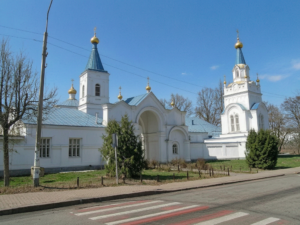
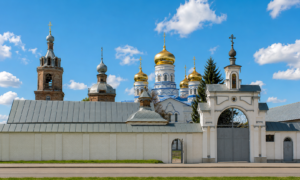
Lost among the quiet Novgorod rivers, on a narrow strip of land between Polisti and its tributary Snow, stands the Kosinsky Monastery. This place from time immemorial is called Spit — in the shape of a cape, washed by water on both sides. Here, three kilometers from Staraya Russa, time seemed frozen in the dilapidated walls of the majestic cathedral and the snow-white restored church, whose appearance keeps the memory of the harsh ascetics of the XIII century.
The silence of the local forests was first violated by two monks of the Khutyn monastery — Constantine and Cosmas. Disciples of the famous Barlaam, they left the habitable cells around 1220, seeking not fame, but complete solitude. Here, on a deserted piece of land, the hermits cut down the first buildings and laid a small stone temple in the name of Nicholas the Wonderworker. Thus began the history of the man’s monastery, which was destined to live for five long centuries – full of prayer, ruin and miraculous rebirth.
Constantine became the first abbot of the assembled brethren. After his peaceful death in about 1240, the reign was assumed by a faithful companion Cosmas. Their common tomb to this day is hidden under a bush of land on the territory of the monastery — an invisible foundation on which the spiritual life of this corner has been kept for centuries. In the XV century, the stone St. Nicholas Church rose here, later it was supplemented with a wooden one — in the name of St. Varlaam Khutynsky, the heavenly patron of the whole district.
The Swedish invasion of 1613 boldly abode from the face of the earth. For twelve years there was desolation, until the monastery was rebuilt. However, the main blow did not come from foreigners. In 1764, the Catherine Reform abolished the monastery, reducing the ancient temples to a modest parish status. For almost a century and a half, oblivion hung over the Spit, until at the end of the XIX century an unexpected renewal came.
In 1885, a women’s community settled near the walls of the former monastery, eleven years later transformed into a full-fledged public monastery. It was then, at the very end of the XIX century, a grandiose construction unfolded here: the extensive five-domed cathedral of Varlaam Khutynsky with a high bell tower above the western entrance rose. Nearby grew a three-storey abbot corps — but not simple, but with a built-in house church of the Assumption of the Mother of God. The territory was surrounded by a brick fence with turrets and elegant gates, put a gatehouse. Behind the perimeter stretches a whole economic kingdom: a wooden hotel, a school with a house for a priest, a bath, a stable, a glacier, a good cattle yard. By 1913, the new female monastery was inhabited by more than seventy people — nuns, novices, ghosted in the old lady’s almshouse.
The Soviet era walked these walls mercilessly. In 1920, the monastery was closed, sixty inhabitants dispersed, and the buildings were transferred to the agricultural artels and the House of the Disabled. The last point was set in 1938: both churches were closed “at the request of believers,” a characteristic formulation of those years. One was given to the school, the other to the museum. During the war, the Germans stood here: the headquarters were placed in the Nikolsk temple, bread was baked on the territory for the occupiers, and the shell that hit the bell tower of Varlaamov Cathedral began its slow destruction. After the war, they finished their own — the locals dismantled the old walls on bricks for stoves and dacha needs.
Today meets the pilgrim in contrast. The small white church of Nicholas the Wonderworker, restored in 2000 by the efforts of local residents with the blessing of Novgorod Archbishop Leo, shines with fresh whitewash. And the huge cathedral of Varlaam Khutynsky still stands in silent reproach — dilapidated, with gaping window failures. Since 2003, the monastic life has been warmed up here again. Abbot Nadezhda and her sisters took on a seemingly unbearable task — the revival of the monastery from the ashes. Kosinsky Monastery today is not a museum showcase, but a living organism that heals the wounds of the past century. Amid the densely sprawling surroundings of dachas and the rustling of coastal grasses, the ancient monastery learns to breathe again, keeping in mind the memory of two humble disciples of Varlaam who came here for silence almost eight centuries ago.
Charity FundHoly Land.
Russian Temples and Monasteries