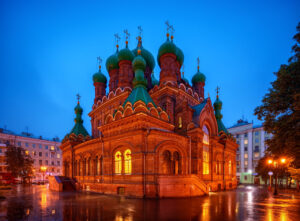
The cathedral was laid at the behest of Tsar Alexander III, at the site of the death of his father, Alexander the Liberator. That is why he is better known by his popular name — Spas-on-Blood.
The temple was literally built by the whole world. Money was sent not only from all over Russia, but also from abroad. The walls of the bell tower are decorated with coats of arms of provinces and cities that participated in the collection of donations.

Construction
The cathedral was built for 24 years, but the result was amazing. The architectural style is pseudo-Russian, clearly resembles the Cathedral of Basil the Blessed. Many unusual architectural solutions were used in its construction. So, it is not built on stilts, but on the foundation, although the channel flows very close. On a solid foundation, walls were erected, which were then faced with red brick. Bricks were ordered in Germany, and marble cladding was brought from Estonia. Watering tiles and colored tiles were made by Russian masters. 9 chapters of the cathedral were covered with multicolored jewelry enamel. Its recipe has no analogues, it was invented and used in the factory Postnikov.
In 1897, a cross was solemnly raised to the central head. Second cross crowned
bell tower.

Interesting facts
1) The building was completed in 1897, but finishing work was carried out for another 10 years. No wonder, because in the cathedral there are the largest mosaic paintings in Russia. 7500 square meters are covered with mosaic scenes from the Bible and ornaments.
2) The temple was electrified with 1,700 light bulbs.
3) The height of the cathedral is 81 meters — Alexander died in 1881. The height of the bell tower is 63 m. The emperor was so old at the time of the assassination.
(4) Although the cathedral is large and can accommodate more than one and a half thousand parishioners, it was not publicly accessible. You can enter only with special permission.
(5) But under Soviet rule, the cathedral became a cathedral until it was closed in 1930.
(6) Inside the cathedral, under the jasper shade, the place of the death of Alexander II is marked. This is part of the embankment: pavement, canal grid, sidewalk slabs.
7) In 1961, during repairs, an unexploded fugas stuck in the ceiling was found. The shell has been there for 18 years.
(8) In 1970, the building was transferred to the Museum of St. Isaac’s Cathedral, where it still belongs.
(9) Services in the temple are held on Sundays and public holidays. So the cathedral can visit not only curious tourists, but also Orthodox pilgrims.
Charitable Foundation Holy Land
Russian Temples and Monasteries