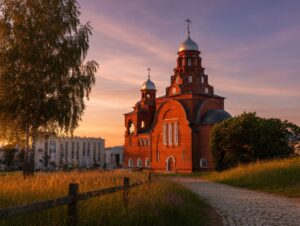
The echo of the Bolshaya Morskaya market breaks on the stone arches unexpectedly, respectfully dying down. Here, at a distance from the tram bustle of the early 20th century, the cathedral grew — not suddenly, but difficultly, for a long time, as if growing through limestone. 1892 Architect Valentin Feldman did not conceive a replica or stylization. He breathed contemporary engineering into images spied from centuries: tent-roofed completions that still remember Ivan the Terrible, but retold in the language of modern times.
For thirteen years, craftsmen laid out walls from Inkerman stone. The more noble Krymbalsky, glowing in the sun, went to the corners. By the winter of 1905, the five-domed mass had finally taken shape. On the twenty-sixth of February, Bishop Nikolai of Tauride and Simferopol, as well as the rector of the Chersonesos monastery Innokenty, and the city clergy performed the first consecration. That same spring, on the third of April, Innocent consecrated the left side chapel in the name of the Great Martyr Panteleimon. And by October, the Synod elevated the Church of the Intercession to the rank of the main city cathedral.
Feldman built the basilica, but every detail betrays its Russian heart. The eye is drawn to the wide molded belt of cornices, semicircles of kokoshniks, and above — to the pointed arch of the main dome. Almost eighty-two square meters of area are crowned by four twelve-sided towers, each covered with a tent, and that topped with an onion. A belfry rises from the west — faceted, topped with a high tent roof, echoing the main volume through an elongated passage. There are two porches: one is hidden in the closed gallery of the main entrance, the second opens from the north.
In 1916, the silence of the crypts was disturbed by someone else’s funeral. Here, under the church floor, Lieutenant Pyotr Schmidt and the sailors of the Ochakov — Sergei Chastnik, Alexander Gladkov, Nikita Antonenko — lay down for a while. Seven years later, in November 1923, during a funeral march, the remains of the revolutionaries left the church grounds for the Communards cemetery.
The war hit Sevastopol with bombs. The shell tore out the southern limit of the cathedral with a direct hit, turning the altar into a pile of stone. After the victory, the temple was patched up — but rather for formality. They stopped serving here in 1962. For seven years, gymnastic equipment and archive folders were crowded within the walls of the former cathedral. By 1969, the temple was finally given over for the storage of documents, the crosses and domes being swept away as unnecessary decoration.
Only in 1992 was the northern aisle returned to the community — the same one in the name of Panteleimon. Two years later, the entire building was given to the Church. By the centenary, the cathedral had regained its war-scarred southern border, a renewed façade and gilded crosses.
Today the Intercession Cathedral is not a decoration or a museum. On a clear morning, the sun’s ray is crushed in the kokoshniks, and it seems that the stone, which survived the empire, war and oblivion, is still breathing.
Charity FoundationHoly Land
Temples and Monasteries of Russia