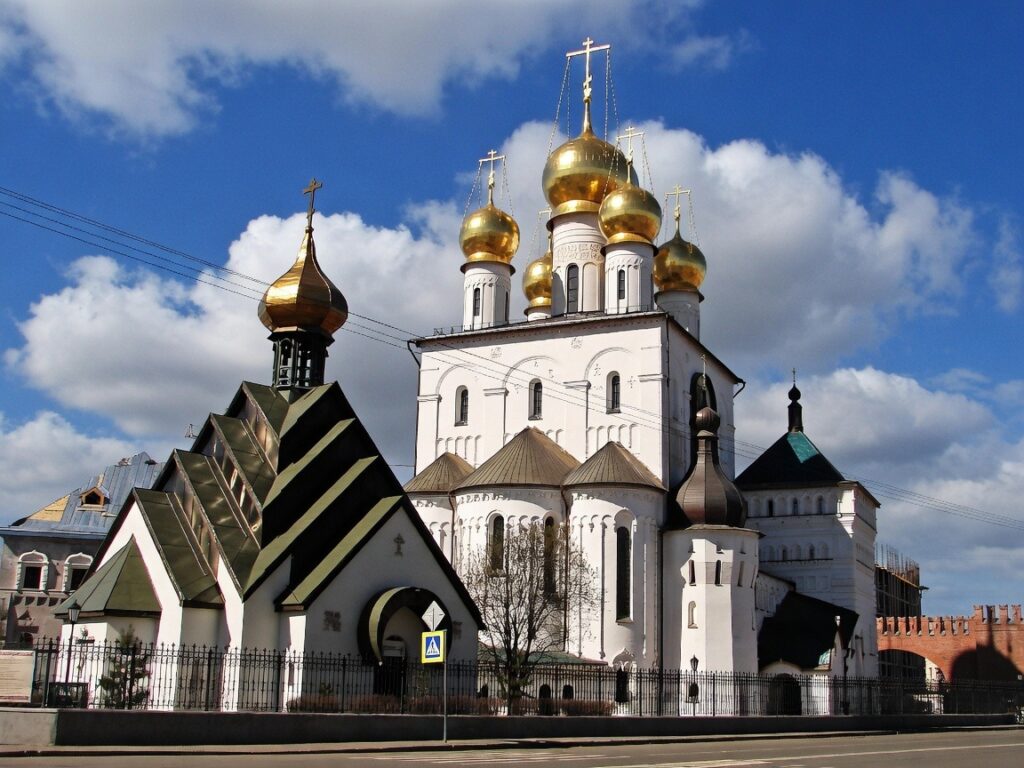
The idea of erecting the Fedorovsky Cathedral in honor of the 300th anniversary of the Romanov House arose in 1907. The winner of the architectural competition was engineer S.S. Krichinsky, who proposed a project in the traditions of Rostov temples of the XVII century. The solemn laying of the two-storey reinforced concrete building took place in August 1911. The exterior turned out to be eclectic: it combined motifs of Novgorod, Pskov and Vladimir-Suzdal traditions. The facade, lined with old stone, was decorated with the majolica family tree of the Romanovs and the mosaic image of the Savior.
The cathedral accommodated about 3,500 people. The lower temple in the name of Alexander Nevsky was made in the Novgorod style of the XIII century, and the upper, columnless Feodorovsky temple — in Rostov. The best masters participated in the decoration: the five-tier iconostasis was cut by the workshop of I. Dikarev, the images were written by famous isographs, and the utensils and bells were cast by the company Olovyanishnikov. Due to the First World War finishing work was suspended. In 1932, the cathedral was closed, its domes were demolished, and the unique building was rebuilt into a dairy plant. In the 1970s, before the visit of US President Richard Nixon, the remnants of the drums were finally dismantled, depriving the building of the church appearance.
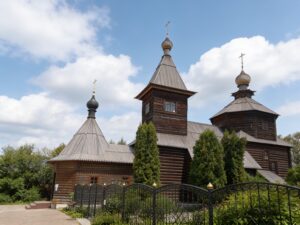
The revival of the shrine began in 1993 with the decision to relocate the plant. Nearby was built a wooden temple of the New Martyrs. In 2005, the cathedral was returned to the dioceses. Under the patronage of B. Gryzlov, a large-scale restoration began. In 2011, a recreated bell ensemble was raised to the bell tower, and in 2013 the mosaic of the Savior was restored. On September 15, 2013, Patriarch Kirill performed a great consecration of the upper church, and the architectural monument found a second life.
Charity FundHoly Land.
Russian Temples and Monasteries