There was a temple in Kursk dedicated to St. Sergius of Radonezh. There was trouble, he burned to the ground. With sadness in my heart came the parishioners to dismantle the rubble. And now, on the ashes, among the still smoldering heads, they found the icon of the Mother of God of Kazan, completely whole.
Taking this as a sign, the parishioners decided to build a new temple on the same place. In 1752, construction of a two-storey church began. They decided to dedicate the lower floor to St. Sergius, and the upper floor to the Kazan Virgin.
Funds were collected among the parishioners. Everyone gave as much as he could, but the main contribution was made by merchants. The brick was supplied by Isidor Moshnin, he owned several factories for the production of bricks. Only Isidore himself did not live to see the completion of construction. After his death, his wife, Agafia, took over. I followed the production and construction. One day, together with her son Prokhor, who was 7 years old, she climbed to the very top of the bell tower. A curious boy came to the very edge and fell from a height of 7 meters. Straight to the construction site, covered with broken brick, logs, garbage. Prokhor rose from the ground as if nothing had happened. Not a single scratch. As a child, God has chosen His chosen one. The boy grew up, went to a monastery. He adopted the name Seraphim. We know him as St. Seraphim of Sarov.
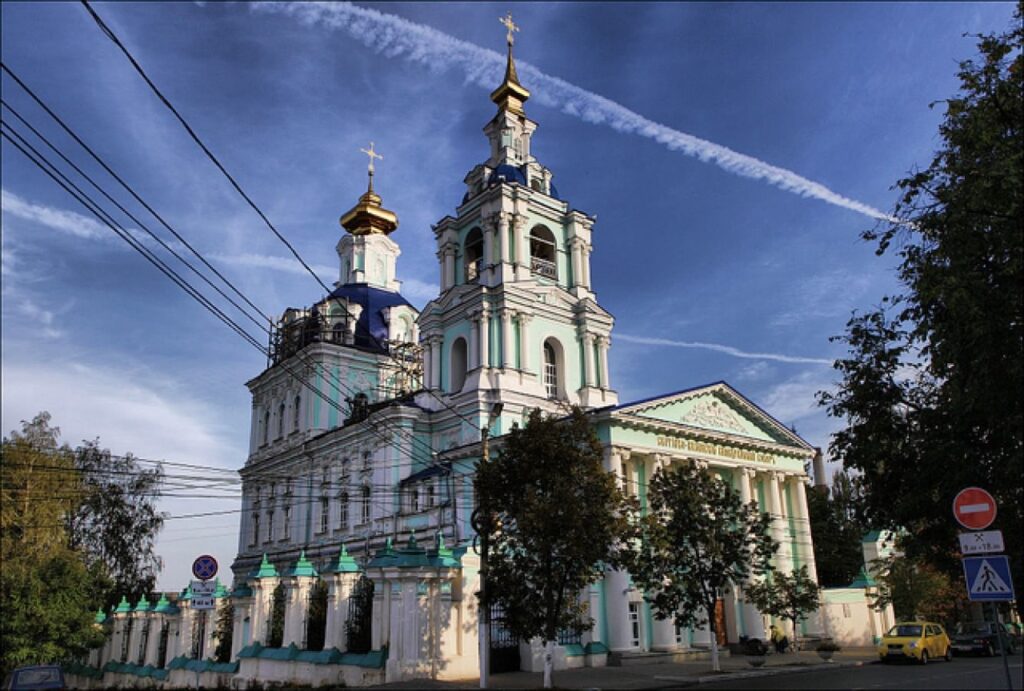
It was built for a long time, it was completed only in 1778, although the lower temple was consecrated in 1762.
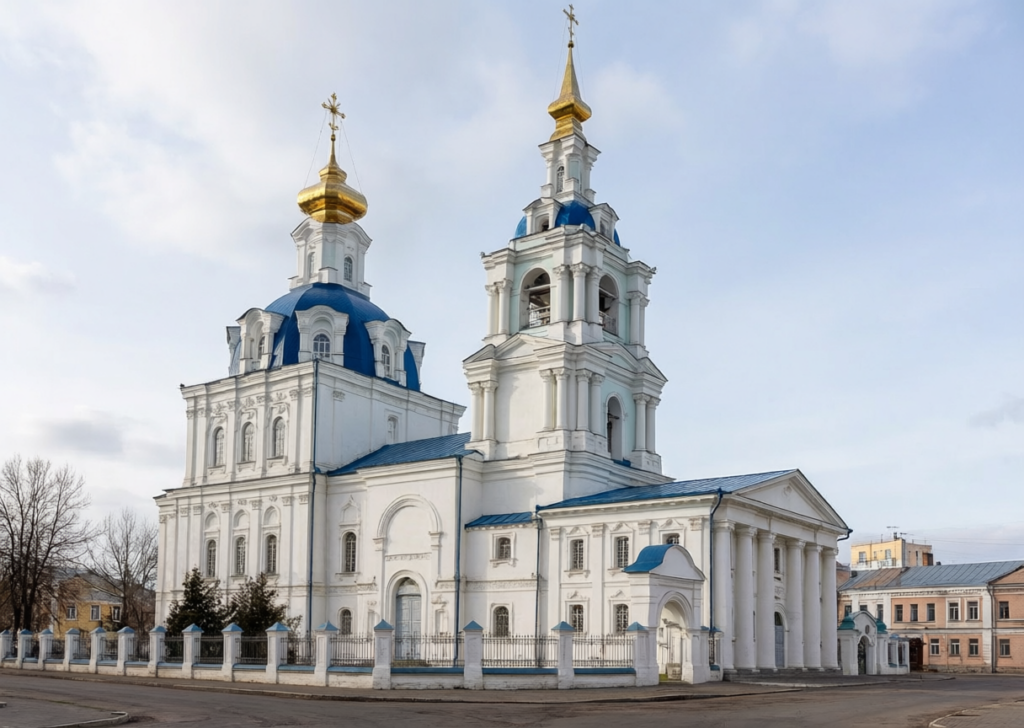
Although the building was built in the tradition of the Rastrelli school, there is no evidence that the architect himself made the project. It was probably done by one of the students.
In 1833, the cathedral received the status of a cathedral. After the Crimean War, the banners of the Kursk squads were kept there.
Throughout the 19th century, the cathedral was rebuilt and improved. Then, instead of open stairs, a cage in the Empire style was attached, which was not very combined with baroque and lengthened the building, violating the proportions. Then they rebuilt the fence due to dilapidation.
After the revolution, all valuables were removed, but the temple continued to function until 1934. A museum was opened in the building.
During the war, some of the exhibits were taken out, and some were walled up in the walls of the cathedral. But the Nazis found the hiding place, and took the paintings to Germany. Oddly enough, they allowed services to resume in 1942. The cathedral has not closed since that day.
After the war, repairs were carried out there and the churches were re-consecrated. It was officially registered in 1993.
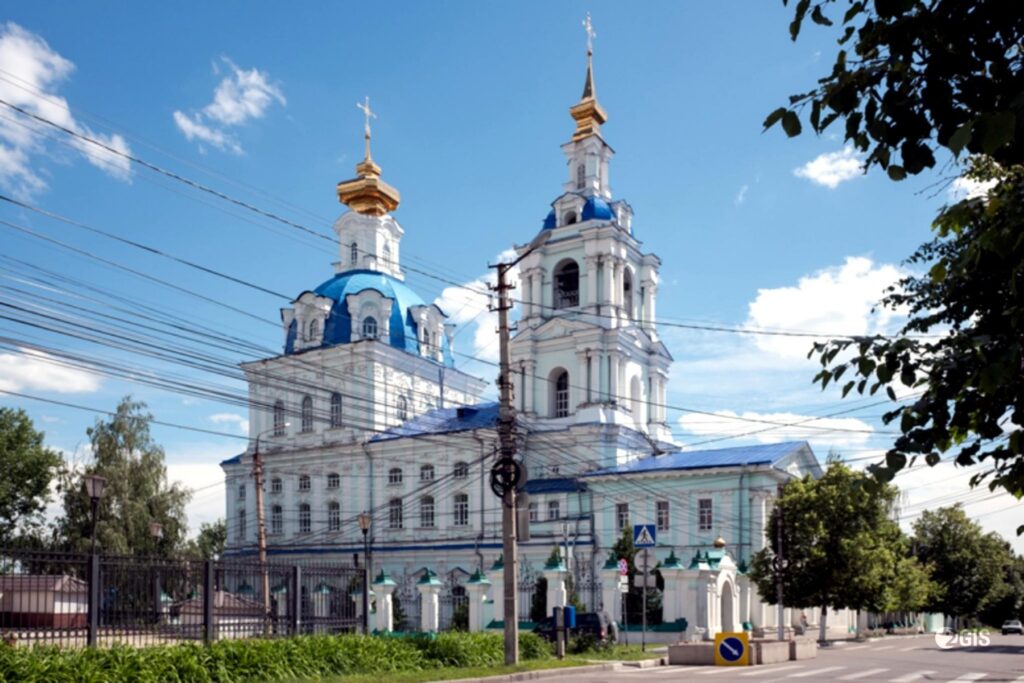
To the 250th anniversary of Seraphim of Sarov, in 2004, a watercourse chapel was built on the territory of the temple, and on the site of his fall from the bell tower — a shaft.
Alas, the restoration of 2006 caused more damage to the building than the Bolsheviks and fascists. Parquet of valuable woods was replaced by linoleum, and forged crosses on the domes were replaced by a new product of poor quality.
Shrines
The icon of Seraphim of Sarov, with a particle of relics, the Kuryans are especially revered. Pilgrims also seek to enter the temple to pray to the saint.
Cancer in the upper temple contains the relics of 40 saints from Andrew the First-Called to Alexander Nevsky.
Charitable Foundation Holy Land
Russian Temples and Monasteries