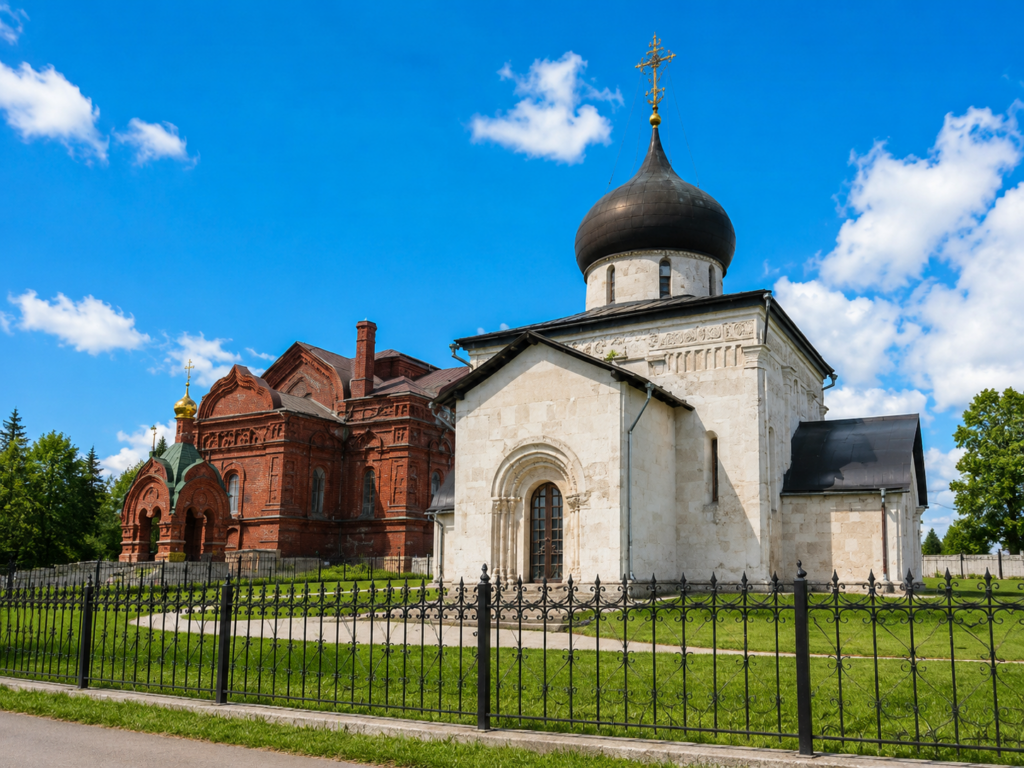
Among the quiet alleys of Yuriev-Polsky lies the cathedral, which is called the last white-stone poem of pre-Mongol Rus. When you look at its walls, there is a strange feeling: before you is either a temple or a bizarrely folded puzzle. Lions, griffins, faces of saints and mysterious centaurs intertwined here in a stone carpet, the meaning of which scientists are still unraveling.
The customer of this miracle was Prince Svyatoslav Vsevolodovich. In 1230, he ordered to dismantle the dilapidated church, standing since the time of Yuri Dolgoruky, and to build something unprecedented. For four years, the artel of carvers covered the facades with a continuous line of images — from the sole to the top. The chronicler did not hide his admiration: «The church is wonderful green.» The temple came out slender, directed upwards, with three porches and a two-tier western volume, where the princely choirs were located. Corner columns crowned with unusual three-sided capitals with faces of saints.
The main treasure of the cathedral is its carved dress. Here come to life healers and warriors: Panteleimon, Dmitry Solunsky, George of Cappadocia. Fantastic sirins, leopards and lions march along the eaves, which served as princely emblems and portal guards. There is a unique character for ancient Russian art — an elephant. A separate mention deserves«Svyatoslav cross»: composition of the Crucifixion with the upcoming ones, where the drooping head of Christ is filled with piercing sorrow. This work is compared to the Italian Ducento.
In the XV century, a magnificent building collapsed. It was restored by the Moscow architect Vasily Ermolin. He carefully collected the surviving carved blocks, but folded them without the previous logic, turning the facades into an intricate mosaic. The proportions became different — the cathedral sat down, lost its former lightness. Later, a classic bell tower, a sprawling Trinity chapel, a sacristy were added to it, and the ancient temple almost drowned among the newcomers. Only at the beginning of the last century, a true masterpiece began to be freed from layers, returning it, albeit not the original, but close to the historical appearance.
It’s quiet inside today. The space is covered with closed vaults, based on four pillars. In the interior, you can see the reliefs transferred there: the Small Deisus and the famous “Crucifixion”. Once the cathedral served as a model for the first stone temple of Moscow — Uspensky, founded in 1326.
The ancient walls are now closed to visitors. White stone sharpens the groundwater, and restorers are preparing for the most difficult operation to save the monument. But even through the scaffolding, a sense of miracle breaks through: the carved faces, who survived invasions, collapses and oblivion, patiently wait for their stone chronicle to sound again in full voice. This cathedral is not just architecture. It is a message encoded in limestone nearly eight centuries ago.
Charity FundHoly Land.
Russian Temples and Monasteries