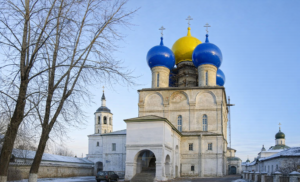
Boris and Gleb are the first Russian saints. People began to venerate them immediately and it is not surprising that, according to legend, Yuri Dolgoruky dedicated a monastery to the saints. However, no documentary evidence of this has survived. The monastery was first mentioned only in the 15th century, in the will of another Yuri, Prince Dmitrievsky.
The monastery was a princely one, and apparently not poor. But the stone temple was built only in 1537. Boris and Gleb Cathedral complies with all the canons of Russian medieval architecture. The temple has four pillars, with two altars. There were 2 chapters, but only one survived.
Like all the surrounding areas, the monastery was badly damaged during the invasion of the Poles in 1610. Then the archive and living quarters burned down, but the cathedral survived. It took 10 years to restore it. And in 1672, trouble came again — a powerful fire turned most of the buildings and the fence into firebrands. They began to restore them in stone. The monastery was surrounded by a stone fence with holy gates, St. Nicholas Church was built, and a little later — Intercession
In the 18th century, the monastery lands were requisitioned by the treasury and construction came to a standstill. Repair work was carried out, but the architectural appearance did not change. However, the monastery was active, there were inhabitants in it. Moreover, the monastery kept a handwritten chronicle until the 20th century.

Before the First World War, donations were sent to the monastery, renovation of the buildings began, but then the war broke out, and then the revolution. In order not to close the monastery, an agricultural artel was formed on its basis, but already in 1918 all the inhabitants were transferred to other places. For some time, novices who arrived from Western Ukraine lived in the monastery, but in 1926 the monastery was finally closed.
First, the buildings were given to the local history museum, then the museum was transferred to the cathedral. A branch of the GULAG, Dmitlag, was opened in the monastery. The prisoners built the Moscow-Volga canal, and the guards lived and worked in the monastery buildings. After the war, a military unit was stationed there, and when it was relocated, the buildings were used for various institutions.
The monastery was returned to the church in 1993. Restoration work began immediately. Unfortunately, during their course, architectural elements of the Middle Ages were destroyed. Thus, during the reconstruction of one of the towers, a tempera drawing dating from the 16th century was lost. The old windows were blocked
new ones have been made in the blank walls, which only look “antique”. However, the main buildings were restored. By the end of the nineties there were 8 inhabitants in the monastery.
The monastery is small, but well-kept. Services are held in the cathedral. There are few visitors, but they all say that there is a sense of peace and tranquility in the monastery.
Charitable Foundation Holy Land
Temples and Monasteries of Russia