Above the quiet Eye, among the old streets of Murom, whitewash the walls of the monastery, remembering and formidable kings, and Polish sabers, and the flames of fires. The Annunciation Monastery is a place where prayer did not stop even when the brethren were dispersed, and the temple was turned into a parish church. His fate is woven from loss and miraculous rebirth.
The roots of the monastery go deeper than its official date of foundation. Tradition calls the first builder of Prince Konstantin Svyatoslavich, grandson of Yaroslav the Wise. He arrived in pagan Murom with his sons Michael and Theodore, dreaming of enlightening the region with the light of Christ’s faith. The mission began tragically: the townspeople met the prince with hostility, and young Michael was martyred. Shocked by the miracle of the image of the Virgin brought from Byzantium, the pagans repented and were baptized in Lake Kstovo. On the old settlement, a wooden Annunciation Church was erected, at the walls of which the entire princely family gradually rested. Local veneration of the Passion-Bearers developed into a general church canonization in 1547.
Five years later, Ivan the Terrible arrived here. Before the decisive Kazan campaign, the tsar fervently prayed to the Murom wonderworkers and vowed: in case of victory, to found a monastic monastery here. The conquest of Kazan was accomplished, and the artel of sovereign architects headed to Murom. When laying the stone cathedral, the builders were waiting for the discovery: ancient tombs with the incorruptible remains of princes were raised from the ground. With prayer singing, the shrine was moved to a new temple. Ivan Vasilyevich generously gifted the monastery: he sent precious utensils, granted extensive lands and ordered to give the brethren “mercy is scarce.”
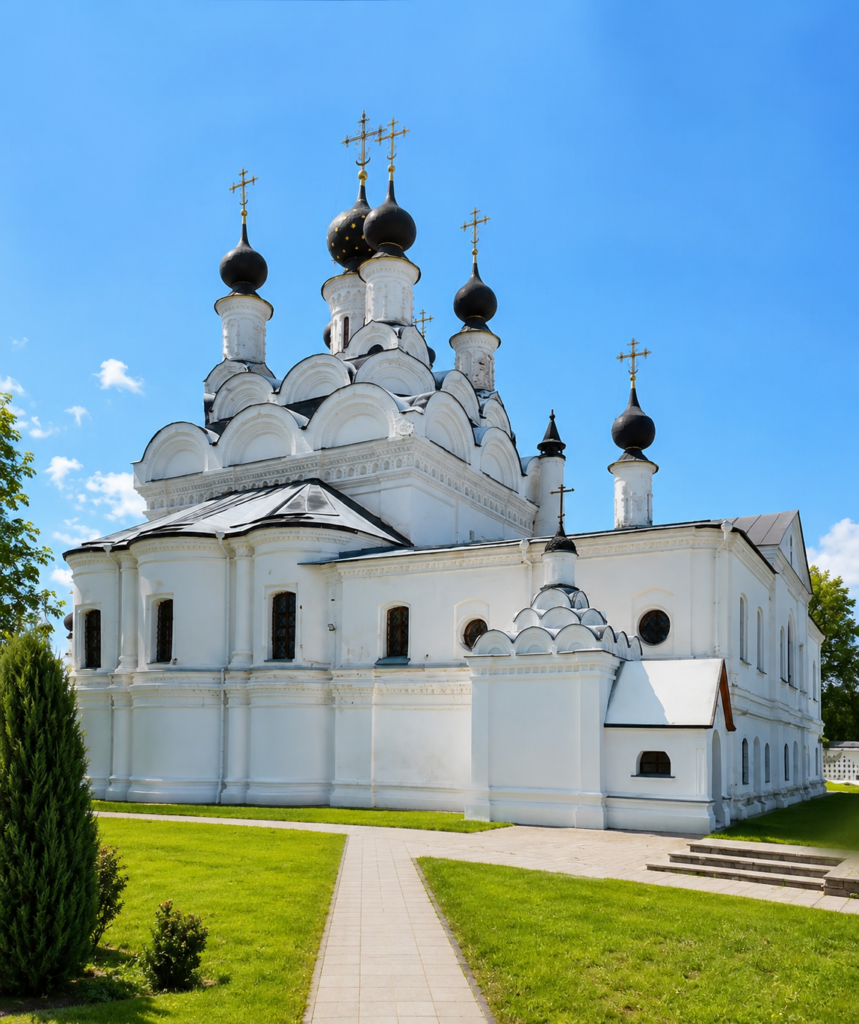
The architectural ensemble of the monastery captivates us with a patchwork – the very Russian style, where every detail pleases the eye. The cathedral, founded under Grozny, gained its current appearance in the 1660s by the efforts of the merchant Tarasy Tsvetnov. The walls are dissected with pilasters, the cornice is decorated with a rhythmic row of niches and cloves, and the trim windows resemble elegant kokoshniks. Take a closer look at the middle window of the lower tier: there lurked a carved two-headed eagle — a rare detail of temple decor. Nearby stands a tent bell tower topped by a clock. Completes the picture of the gate Stefanievskaya church, whose modest forms breathe noble antiquity.
In 1616, the monastery survived the pogrom of Lisovsky’s detachments. Jewels sent by Grozny disappeared without a trace. But the monastery managed to rise. And in the formidable 1812, its walls received shrines evacuated from Moscow occupied by Napoleon: the Vladimir and Iberian icons of the Mother of God. Until October, they prayed for the salvation of the Fatherland. Later, as a token of gratitude, the townspeople established an annual procession of the cross, and the local list of the Iverian image gained special reverence.
The twentieth century experienced the abode on a break. The monastery was abolished in 1919, but the monks did not leave their temple – they settled in the city and continued to serve secretly. In May 1923, the relics of Princes Constantine, Michael and Theodore were opened and sent to the museum, where they lay for 66 years. The cathedral was closed, but not for long: at the height of the war, in 1942, it was returned to the faithful. A curious touch of history — in 1946, Hieromonk Pimen (Izvekov), the future Patriarch of Moscow, served here.
The full revival of monastic life began in September 1991. Today the monastery is again filled with prayer. In the basement of the cathedral rest the relics of St. Basil of Murom and the ascetic Julian. The main shrine is cancer with the relics of Princes Constantine, Michael and Theodore, returned to the Church in 1989. Here are stored the image of Ilia Muromets with a particle of relics, the revered list of the Iberian Mother of God and the icon of Peter and Fevronia.
The monastery did not become a frozen monument. Divine services are performed daily, educational work is carried out. In the necropolis near the walls of the cathedral, eminent citizens found peace. Archimandrite Alexy (Polysadov) is buried here — the great-grandfather of the poet Andrei Voznesensky. Fate is so bizarrely intertwined: the royal vow, merchant zeal, poetic blood and a quiet monastic feat came together on this piece of Murom land to remind: true faith does not die. She’s just waiting.
Charity FundHoly Land.
Russian Temples and Monasteries