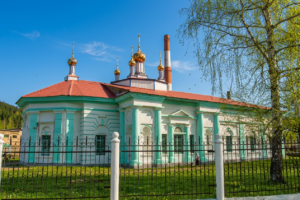
We know: God is everywhere. He is not confined within walls, not tied to any point on the map — His presence fills the whole world. But there are places where this closeness is felt especially strongly. Temples become just such places. That’s what they call them—the house of God. Not in the sense of “a building that belongs to God,” but as a space where the meeting with Him becomes real, tangible, almost tangible.
They don’t just come here to light a candle or quickly read a prayer. They come here to be together — both with God and with each other. The community gathers in the temple, people become one people, who together turn to the Lord. This is the meaning of worship: not everyone on their own, but all together. And here we remember the words of Christ: “Where two or three are gathered in My name, there I am in the midst of them” (Matthew 18:20). They contain the whole essence of conciliar prayer. If even a few people gathered for the sake of God already become the place of His presence, then what can we say about the whole temple, where hundreds of voices sound, where hearts beat in the same rhythm, where everyone adds to the common prayer his quiet request, his gratitude, his hope.
When a person enters the temple, it is as if he is moving from one world to another. It is not customary here to talk loudly, walk aimlessly or be distracted by trifles. Everything here is subordinated to one thing: attention to God. We stand, listen, try to catch every word of reading and singing, respond to the exclamations of the priest, and join in the common prayer. And in this attention a special feeling is born: you are not alone. Nearby are people who also seek God, who also hope, who also ask for help. And also nearby are those who are no longer on earth: saints and angels. They stand invisibly with us, pray with us. And the temple becomes a bridge between heaven and earth, between eternity and our present day.
Even from the outside, the temple is immediately recognizable among other buildings. It doesn’t look like an ordinary house, and that’s no coincidence. After all, it is dedicated to God, and it is customary to give God the best that you have. That’s why people put so much work, so much love into the construction and decoration of temples. The domes pointing upward seem to show: our thoughts, our hopes reach out to the sky. The ringing of bells, which can be heard for many kilometers, does not just call for service — it reminds that there is something more than vanity and haste. It stops you, makes you raise your head, listen, think.
In church you can pray for yourself and for your loved ones, ask, thank, share what is in your heart. But the main thing is that here you learn not only to speak, but also to listen. Listen to the silence in which the answer sounds. Listen to the voices of other people who turn to God with you. And gradually you understand: a temple is not about walls and not about architecture. It’s about a meeting. About how man finds his way to God, and God to man.
Charity fond Holy Land
Investment in the Soul!