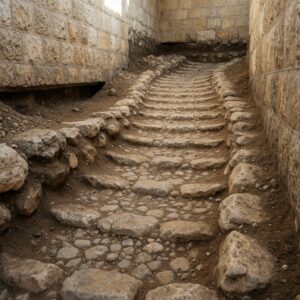
Sometimes history is hidden literally under your feet. Where millions of pilgrims have bowed their heads in prayer for centuries, scientists are bringing back the past step by step — stone by stone, layer by layer. This is how a road opened under the Church of the Holy Sepulcher in Jerusalem, which may have touched the soles of those who walked to the place of execution. And, perhaps, Christ was once led along it.
How the stones told their story
Excavations under the temple took a long time and very carefully — from May 2022 to October 2025. We had to work literally between shrines, in cramped spaces under foundations, where every centimeter is part of a thousand-year memory. The work was led by Professor Francesca Romana Stasolla from the Sapienza University of Rome. Her team was looking not for sensation, but for facts: they wanted to understand what this land was like before it became the main Christian sanctuary.
And the facts turned out to be amazing. Under the passage of the Crusader era, archaeologists found a section of an ancient paved road — approximately three by three and a half meters. These are not just cobblestones piled in a row: we have a thoughtful design in front of us. Wide, shallow steps bordered by large stones, a smooth bend and a noticeable slope — all this suggests that the road rose to the southwest, to a hill.
What was it needed for? Scientists have several versions, but one of the most convincing is a suburban path leading to the site of public executions. In ancient Rome, crucifixions were staged in full view of everyone, so that the spectacle was accessible to the crowd. This means that there had to be a convenient and visible approach to the place of execution. This is exactly what the found site looks like.
A garden that confirms the Gospel
But it was not only the road that made scientists hold their breath. At the same time, they studied the remains of plants preserved in the deepest layers. Laboratory analysis yielded an unexpected result: in the pre-Christian era, around 33 AD, this area was actively cultivated. Olives and grapes grew here — in a word, it was a well-kept garden.
This find surprisingly echoes the Gospel of John, which directly says that at the site of the crucifixion there was a garden, and in it a new tomb carved into the rock. It turns out that the landscape described in the sacred text is confirmed by archeology: where the temple stands today, two thousand years ago there really was a garden on the outskirts of the city.
Why the road could not have been just a construction site
Previously, scientists assumed that the pavement could have served as a technical lift for builders in the 2nd century, when Emperor Hadrian was rebuilding Jerusalem. But the design of the road casts doubt on this version. The steps and steep incline made passage of heavy carts almost impossible. This means that this is not a commercial route.
On the other hand, the road is too monumental for a simple path to private tombs. It was clearly intended for a large flow of people. And this again brings us back to the idea of public executions on a hill — that is, to Golgotha.
Disputes and new arguments
Disputes about where exactly Golgotha and the tomb of Christ were located have not subsided for decades. Some researchers defend the traditional site under the Church of the Holy Sepulchre, others consider the “Tomb in the Garden” outside the Old City more likely. New finds do not put an end to this dispute, but seriously strengthen the position of supporters of the traditional location.
It is not a matter of one fact, but a combination of them: the road with a slope towards the hill, and traces of the garden, and the nature of the development on the outskirts of the city — all this adds up to a whole picture. Before Emperor Constantine turned the area into a closed sanctuary, it looked exactly as the evangelists describe it: an open area accessible to the crowd, with a garden and rock tombs.
What this means for us today
It is important to understand: scientists do not claim to have found “the same way” of Jesus. There is no direct evidence of this, and there cannot be. But they found a road that fits perfectly into the historical and geographical context of the gospel events. This is not a proof of faith, but a confirmation that the gospel story does not contradict archaeology.
Research is currently ongoing. Experts are studying every layer, every shard of pottery and every pollen to more accurately restore the topography of ancient Jerusalem. There are plans for the future: they want to make the found section of the road into a museum so that people can see these stones and imagine what life was like in the city two thousand years ago.
Sometimes the most important thing in such finds is not big words, but the opportunity to touch history. To a story that is not about distant legends, but about real streets, gardens and roads along which people once walked — and perhaps one of them changed the world forever.
Charity fundnd Holy Land
Investment in the Soul!