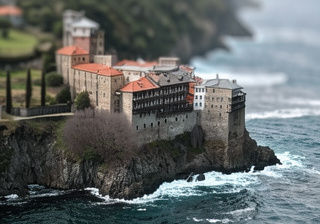
Athos is the spiritual capital of Orthodox Christianity. This is the oldest monastic community in the world.
The first hermit monks began to settle there no later than the 6th century, and after the conquest of Egypt by the Arabs, dozens of Egyptian monks flocked to this secluded place.
Emperor Basil the Macedonian in 885 officially approved Athos as the place of residence for monks. Laymen were forbidden to settle there.
The first Russian monks appeared on the mountain in 1016. In 1169, the monastery of St. Panteleimon officially became Russian. In 2016, the thousandth anniversary of the Russian presence on Mount Athos was celebrated.
Over 13 centuries, the monasteries have experienced a lot. During military conflicts they were devastated, the monks dispersed, but invariably returned and rebuilt the monasteries. Now there are 20 monasteries on the peninsula. All monasteries accept pilgrims, but not all monasteries.
The Holy Mountain has its own rules and visitors are strongly advised to follow them.
What you need to know about Mount Athos before visiting
Geographical location
Athos is a peninsula of another peninsula — Chalkidiki. You can only get there by sea or by helicopter. There is a way by land, but it is only on foot and difficult. In addition, Athos has a real border, which is surrounded by a fence. The land road is used only in extreme cases, when there is a storm at sea, the weather is bad, and the matter cannot be delayed.
Climate
The climate is mild, Mediterranean. Summers are hot, winters are rainy, and snow occasionally falls. Although the temperature rarely drops below zero, high humidity and wind from the sea make it feel more cold. To visit Mount Athos, you need to dress warmly in winter.
Administrative structure
Mount Athos is an autonomous monastic republic within Greece. It has its own capital — Karya. The republic is governed by the sacred Kinot, which includes representatives of all 20 monasteries. Every year the composition of the Cinema changes. The Holy Mountain is under the jurisdiction of the Patriarch of Constantinople. Secular power is represented by the Greek governor.
Roads
As such, roads appeared on Mount Athos only in the 20th century. They are unpaved and vehicles use them mainly to deliver goods. Residents and pilgrims travel on foot. There are few roads on the Holy Mountain, but many paths. It’s easy to get lost. Therefore, it is strongly recommended not to walk around the peninsula alone.
Clothing
In the summer, a sun hat and glasses will come in handy. In winter — a waterproof jacket, a warm sweater. Comfortable shoes at any time of the year. Shorts and short-sleeved shirts are not allowed here. Shoes must be closed-toed, no sandals.
Money
All payments on Mount Athos are made in euros. Boat tickets, goods in the monastery shop — whatever you buy, have European currency ready.
Accommodation and meals
Accommodation and meals on the mountain are free. The food is delicious and filling. On Sundays, wine is served with the meal. The cells are Spartan, but all amenities are in the common corridor.
Customs
Only souvenirs and goods purchased in the monastery shops can be exported from the peninsula. The export of icons, books, and religious utensils is prohibited. Upon departure, pilgrims undergo customs control.
Rules
• Only men can visit the Holy Mountain. Women are prohibited from approaching the peninsula closer than 500 meters. There are no female animals on the peninsula. The same rule applies to children and adolescents under 16 years of age.
• All pilgrims must obtain a special permit, diamonitirion, in the city of Ouranoupolis, from the pier of which ferries run to the peninsula.
• Time on the peninsula is Byzantine, midnight comes with sunset. Taking pity on visitors, the monks usually call Greek time, but services are held in Byzantine time.
• Pilgrims living in the monastery must attend all church services together with the brethren.
• Participation in labor obedience is encouraged.
• Pilgrims are gently advised not to talk or laugh loudly, and not to use cell phones telephones.
• Swimming in the sea, fishing, picnics and other entertainment of this kind are not blessed.
• Only those who confessed and received a blessing the day before are allowed to receive Communion.
• Pilgrims eat food in the refectory, together with the brethren. Monday, Wednesday, Friday are fast days. On Wednesday and Friday, monasteries usually have one meal, on other days — two.
• Be sure to take a flashlight with you — the electricity goes out at night.
• The monastery gates close at 6:30 pm and open at 6:30 am. Pilgrims who do not spend the night in the monastery must leave it before the gates close.
Completing all the formalities and remembering all the rules is not easy. In addition, the fear of doing something wrong distracts from the religious spirit. Therefore, it is better to go to the Holy Mountain as part of a group. The Holy Land Foundation organizes pilgrimage trips to Mount Athos, accompanied by an Orthodox guide who is familiar with the rules and traditions of the monastic republic. He will help you figure out the schedule, tell you what is best to do at a certain time, and organize visits to other monasteries.
Charitable pilgrimage trips to Athos, which are organized by the Holy Land Foundation, are a time of removal from sin, a special prayerful attitude, and cleansing from earthly passions. Having visited Mount Athos, believers are transformed internally, grow in faith, and become stronger in the desire to live according to church canons.
Keep in mind that it is almost impossible to get an overnight stay in most monasteries and small cells where two to five monks live. Only the monastery of St. Anne receives pilgrims in the same manner as the large monasteries of Athos.
Charitable Foundation Holy Land
Investments in Soul!