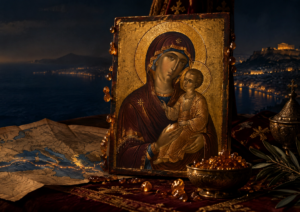
The path of the icon from the monastery to Canada
The icon was painted on Mount Athos in the Nativity of the Savior monastery: the hieromonk made a copy of the famous image of the Mother of God “The Goalkeeper”. The work turned out to be strict and restrained — the kind that happens with masters for whom writing is not a craft, but a prayer.
A year later, Joseph Muñoz-Cortez arrived on Mount Athos — a man of difficult fate: a Chilean of Spanish aristocratic family, a teacher of art history, passionate about icon painting and deeply devoted to Orthodoxy. Seeing the icon, he wanted to buy it. The monks did not agree to sell the image. But when Joseph was already saying goodbye and getting ready to leave, Abbot Clement presented him with an icon as a gift. Before leaving the Holy Mountain, Joseph attached a new image to the original in the Iveron Monastery — according to ancient custom, in order to “convey” the blessing of the prototype.
So the icon went across the ocean to Montreal and took a place in Joseph’s house.
The first miracle
On November 24, 1982, at three o’clock in the morning, Joseph woke up from a strong, unlike anything aroma. At first he thought that the smell came from the relics kept in the room, or from accidentally spilled perfume. Approaching the icon, he froze: the entire surface of the board was covered with an oily, fragrant liquid. Joseph himself later said: “I was frozen in place by such a miracle.”
From that moment on, the icon streamed myrrh almost continuously for fifteen years.
What the myrrh stream looked like
The myrrh came out mainly from the hands of the Virgin and Child, as well as from the star on the shoulder of the Mother of God. At the same time, the back side of the board always remained dry — as if the source was only on the front side. There was so much liquid that it was collected in vessels. On the days of great holidays, the myrrh poured out especially abundantly: it appeared even through the protective glass, flowed down the base, and flooded the table and part of the wall. Most often, the myrrh appeared during prayer — as if the icon was responding to the words addressed to it.
The aroma was described as strong, pure, unlike any earthly smell.
The icon on the road: thousands of meetings
Joseph did not keep the miraculous image with him: he took it to parishes in different countries — America, Australia, New Zealand, Western Europe, Bulgaria. Thousands of people came to the icon. Many cases of healing have been recorded, including from serious illnesses that were considered incurable.
But another thing was no less important: for many, after meeting with the image, their inner lives changed. People found consolation in grief, returned to prayer, and reconsidered their actions and attitude towards others. Not only Orthodox Christians came to the icon, but also Catholics and Protestants: the image seemed to overcome the usual boundaries.
Tragic ending
On the night of October 31, 1997, Joseph Munoz-Cortez was killed in Athens. The circumstances of his death still remain unclear. At the same time, the Iveron Montreal Icon itself disappeared — it was not found either in the hotel room or in Joseph’s Montreal apartment, which was soon robbed. No one has seen the original since.
Continuation in Hawaii
A decade later, in 2007, in Honolulu, in a Russian Orthodox parish dedicated to this particular icon, its paper copy began to stream myrrh. It was an ordinary typographical reproduction pasted onto cardboard — nothing special in terms of materials. It was all the more surprising that it began to exude the same fragrant liquid. Since then, this image has also been traveling, and cases related to it continue to be told.
Myrrh-streaming: a look from different sides
Today, the phenomena of myrrh-streaming are common, and for believers they are a sign of mercy and grace. Skeptics have their own explanations: resin, condensation, temperature changes. However, these versions do not work well when it comes to paper reproductions, photographs, murals or metal images — they can also leak myrrh. It is also not easy to explain why the aroma can be so strong and the amount of liquid so large that it has to be collected in a container.
Terminological clarification is also important: the word “mirro” is used here conditionally. Real church myrrh, used in the sacrament of anointing, is a complex composition of about forty components. What appears on the icons is not connected with this composition, but the tradition of calling the phenomenon that way has long been established.
Not only icons: myrrh from relics and incorruptibility
The miracle of myrrh flow is associated not only with images, but also with the relics of saints. For example, the relics of St. Nicholas the Wonderworker in Bari (Italy) since 1087 have constantly exuded myrrh, which the clergy annually remove through a small hole in the tomb.
Another amazing phenomenon is the incorruptibility of some holy relics. On the island of Corfu, the relics of St. Spyridon of Trimythous have rested for more than one and a half thousand years. They have been repeatedly studied by scientists from different countries, but have been unable to provide a scientific explanation for the fact that the skin on the body remains soft and elastic.
The incident in Ufa
The authors, who happened to witness this, talk about the events of the early 1990s in the Church of the Nativity of the Virgin Mary in Ufa. Then several icons were filled with myrrh at once. The rector of the temple was Archpriest Boris Razveev (now deceased). Large crystal vases were placed under the images, and they were quickly filled with fragrant liquid. This was not an isolated incident, but the simultaneous myrrh streaming of several icons — a rare event and strong in its impact on parishioners.
The history of the Montreal Icon is not just a story about a miracle. This is a story about a man who kept a shrine and shared it with the whole world, about thousands of meetings and hopes, about an inexplicable phenomenon and a sudden, tragic break in the path. The original was never found, but the memory of it lives on in the stories of eyewitnesses, and in new testimonies, and in that same paper copy that continued the tradition on the other side of the world.
Charity fundnd Holy Land
Investment in the Soul!