Christianity took root in the Abkhazian land in apostolic times. Already in the first century, Andrew the First-Called and Simon Cananite, both of the twelve closest disciples of Christ, came here with a sermon. Simon chose a cave near the Psyrtskha River as a place of solitude, where later, in the middle of the first century, he received a martyr’s death from the Roman legionaries in Anacopia. The apostle of seventy Mafias completed his earthly journey in Sebastopolis, the current capital of Abkhazia, Sukhum. In the following centuries, the faith was strengthened by the work of Christian soldiers and church leaders. Among them are the Martyrs of Orentius with six brothers, two of whom found rest in Pitsunda; the passion-bearer Basilisk of Koman and St. John Chrysostom, who died in Kamans in 407. Kamanas entered the sacred history and as the place of the third acquisition of the head of John the Baptist.
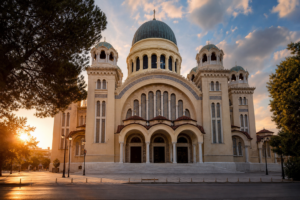
The capital Cathedral in honor of the Annunciation of the Most Holy Theotokos stands in the historical center of Sukhum. The building in the New Byzantine key was completed in 1915 with the funds of the Greek diaspora. Initially, the temple was named after Nicholas the Wonderworker and in everyday life was called the Greek Nikolsky. After the war, the cathedral received the status of a cathedral and a new dedication. In 2011, the government of the republic handed over the building for indefinite gratuitous use to the Abkhazian Orthodox Church. Inside are the images of the Apostles Simon and Andrew, St. Nicholas and St. John Chrysostom, the martyr Basilis. Particularly distinguished are the list of the Iverian Mother of God and the icon of the healer Panteleimon with a particle of relics. The service is performed in three languages: Abkhaz, Church Slavonic and Greek.
The mountain village of Kamana lies fifteen kilometers from the capital, in a gorge on the left bank of the West Gumista River. The name translates as “Holy Place”. There is a male monastery of the IV century in the name of St. John Chrysostom. Monastic life resumed in 2001. The main shrine is a stone sarcophagus, carved from a solid limestone block and weighing about a ton. According to legend, it was here that the incorruptible remains of the great theologian rested for thirty years before being transferred to Constantinople in 438. In the temple there is also an icon of the saint with a particle of relics. Nearby are the cave of the third discovery of the head of John the Forerunner and the chapel of the martyr Basilis, erected above the place of his burial. Nearby beats the revered healing spring, where ablution is performed.
The Anakopian Mountain in New Athos is revered as the lot of the Most Holy Mother of God. At its top there are preserved the ruins of the temple of the VI-VII centuries, in which, according to medieval manuscripts, in the thirties of the eighth century there was a miraculous icon of the Mother of God. The monks of the New Athos monastery in the early twentieth century cleared the rubble and built a small chapel inside the ancient walls of the Iverian image with a well of clean water. At the foot of the mountain is the grotto of the Apostle Simon Cananite, where the saint spent almost two years in prayerful solitude. In 1884, the cave was consecrated and turned into a chapel decorated with mosaics of the Apostles Andrew and Simon. To the grotto leads a path paved with wild stone, running through the gorge of the Psyrtskha River past a huge boulder with a fingerprint resembling a human footprint. Tradition connects this stone with the foot of the apostle himself. It also shows the place of execution of Simon Cananite in 55.
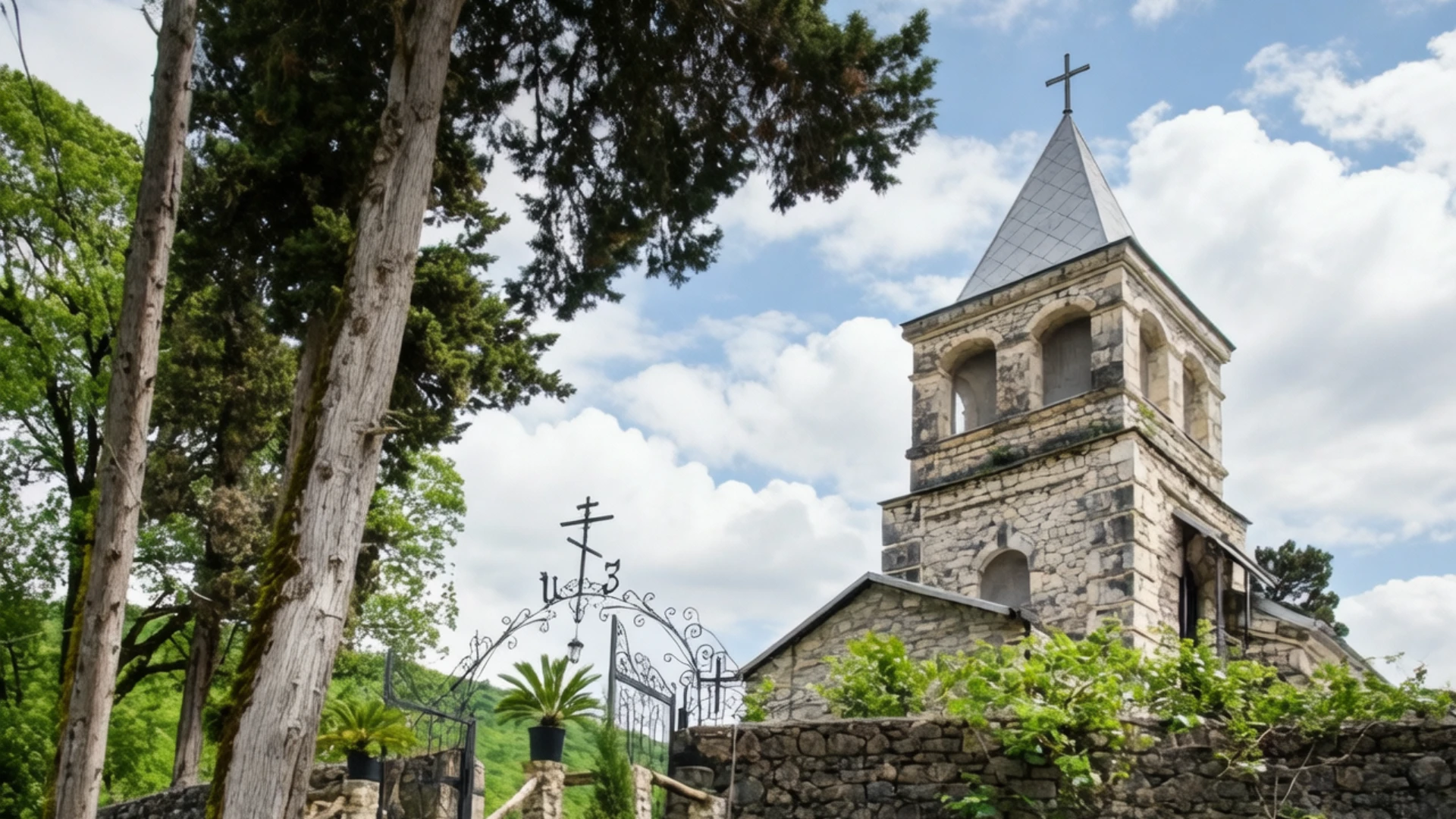
The temple in honor of the Apostle Simon, dating from the IX-X centuries, is built on his relics on top of a wooden church of the sixth century. The white-stone building has retained its original appearance, although inside, under the late plaster, fragments of ancient wall painting are hidden. Today, the doors of the church are opened once a year – on May 23, the day of the memory of the saint. Pilgrims pray at the walls, where a candle burns in a special niche, and a spring beats from the masonry.
The monastery complex of New Athos, built by natives of the Holy Mountain at the expense of the tsarist government, was consecrated in 1900 with the confluence of almost twenty thousand believers. The central building is the Panteleimon Cathedral, the largest church building in Abkhazia, designed in neo-Byzantine forms. The path of sinners rises to him. Among the shrines of the monastery are the icon of the Mother of God “The Redeemer” with the upcoming Apostle Simon and the healer Panteleimon, Anakopi and Pitsunda images, as well as a cross with a particle of the Life-Creating Tree of the Lord.
The pilgrimage route also covers remote shrines. In the village of Drandy there is a monastery with the Assumption Cathedral, built presumably in the VI-VII centuries. Cross-domed temple with Gothic panoramic windows has preserved the oldest frescoes. Here is the myrrh-streaming icon of the Great Martyr Demetrius of Thessaloniki, and the fonts at the source of the warrior Nikita Besogon are equipped on the territory. Further, the path lies in the village of Ilor to the white stone temple of the XI century, consecrated in honor of George the Victorious. Inside are stored particles of the relics of the Great Martyr, the myrrhaging images and icon of the Abkhazian passion-bearer Eustathius of Apsil, who died by an Arab commander in 738. The route ends in the village of Mokva at the Cathedral of the Assumption of the Most Holy Mother of God. The cross-domed building, close in proportion to the Kiev Sofia, was erected by the Abkhazian king Leon III in the sixties of the tenth century. The fresco decoration dates back to the twelfth century. On the territory to this day there is a holy well.