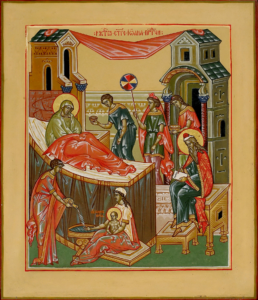
On Tuesday,7 July, The Orthodox Churchwill celebrate one of thegreat holidays — Christmas of the honest glorious Prophet, Forerunner and Baptist Lord John.
The celebration is dedicated to the birth of the one who prepared humanity for the coming of the Savior and was honored to personally baptize Him in the waters of the Jordan.
According to the gospel narrative, the birth of John to elderly parents — the priest Zechariah and the righteous Elizabeth — was accompanied by a series of signs. Archangel Gabriel announced to Zechariah about the imminent fatherhood right in the temple, but he doubted what he heard and remained mute until the naming of the baby. The gift of speech returned to him only after the name John indicated by the angel was inscribed on the tablet. Elizabeth herself, having been relieved of her burden in old age, became another living proof that the “almighty Hand of God” is capable of overcoming the laws of nature. This event preceded an even more incomprehensible miracle — the birth of Christ from the Virgin Mary.
Tradition has preserved dramatic details of the early years of the life of the future Baptist. When King Herod, frightened by the news of the birth of the Messiah, ordered the destruction of the babies in Bethlehem, the son of Zechariah was also in danger. Fleeing from persecution, Elizabeth took refuge with her child in the desert. At the mother’s prayer, the mountain parted, hiding them in a cave from the soldiers. Meanwhile, Zechariah, who refused to reveal the whereabouts of his son, was killed right in the temple, between the altar and the sanctuary. The orphaned John remained in the desert, where, according to his life, he ate locusts and wild honey, guarded by angels until the day of his appearance to the people of Israel.
The Feast of the Nativity of John the Baptist was established by the church calendar at the beginning of the 4th century. Historically, the celebration took place during the summer solstice, which left its mark on the folk traditions of the Eastern Slavs. In the pre-Christian era, Kupala was celebrated on these days, the rituals of which included the worship of fire, water and the collection of herbs. With the adoption of Christianity, the church date filled the ancient natural cycles with new content. Over time, the word “Kupala” began to be perceived as a popular nickname for the saint himself, associated with the rite of baptism, that is, immersion in water.
Researchers of traditional culture note that efforts to overcome the pagan elements associated with this period of the calendar continued for centuries. Back in the 16th century, “Stoglav” mentioned the remnants of wicked games, but by the beginning of the 20th century, according to the observations of ethnographers, serious superstitions were practically crowded out or transformed into harmless folklore elements. Today the feast reminds believers of the witness of the man whom Scripture calls the greatest among those born of women, and of his preaching of repentance that prepared the way for the Gospel.
Days of Remembrance
January 20 — Council
March 9 (transitionable) — The first and second finding of the head
June 7 — Third finding of the head
July 7— Christmas
September 11 — Beheading
October 6 — Conception
October 25 — Transfer of the right hand from Malta to Gatchina
Charity FondHoly Land
Investment in the Soul! News