September 11The Orthodox Church recalls one of the most dramatic events in New Testament history – the execution of John the Baptist. The holiday is called solemnly and strictly: “The beheading of the honest head of the glorious Prophet, Forerunner and Baptist John.” On this day, believers hold a strict fast — not for the sake of physical purification, but as a sign of sorrow for a man who died for not being afraid to tell the truth to the powerful.
What happened?
This is what evangelists Matthew and Mark tell us. Herod Antipas, the tetrarch of Galilee, took his wife from his brother Philip, Herodias, and lived with her. John the Forerunner, a man uncompromising and straightforward, publicly called it lawlessness. Herod answered how often the authorities responded to an inconvenient truth: they imprisoned the accuser in prison. The people considered John a prophet, and the anger of the crowd frightened the ruler more than the words of the prophet himself.
The end came at the feast. Salome, the daughter of Herodias, danced in front of the guests, so that Herod, hot with wine and admiration, swore: Ask for anything, up to half the kingdom. Salome, taught by her mother, asked not for wealth or power — she asked for John’s head on a platter. The Gospel says that Herod was grieved, but the oath made before the guests proved to him more precious than the life of an innocent man. The executioner entered the prison, cut off the head of the prophet and brought it to the girl.
Why is it important?
John the Forerunner is an exceptional figure. He is the last of the Old Testament prophets and at the same time the first to point to Christ. He baptized Jesus in the Jordan. He was called “the forerunner” – the one who went ahead. And his death was not an accidental tragedy, but the last act of prophetic ministry: he testified to the truth to the end and accepted death without retreating.
The Church sees several lessons in this event. John is an example of how truth is more important than security. Herod is an example of a weak ruler who knows that he is doing wrong, but does not find the strength to resist the pressure of the environment. And Salome and Herodias are a reminder of how talent and beauty can serve cruelty when ruled by malice.
The three discoveries of the chapter
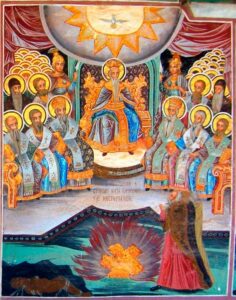
After the execution, the head of John became one of the most revered shrines of Christendom. Tradition speaks of three acquisitions — cases when the head was found, lost and regained. The first and second acquisitions are celebrated on March 9, the third on June 7. Each time the discovery of the shrine was accompanied by miracles and became an event of a church-wide scale.
Folk customs
In Russia, the holiday took root under the harsh folk name “Headsack”. The peasants on this day did not take a knife in their hands, did not cut bread and generally avoided everything round that required cutting — watermelons, onions, apples. Bread was broken by hand. This was not due to the church’s rules, but to folklore perception: cutting a round object meant repeating the beheading. They also avoided fun, singing, and dancing, especially dancing, because it was the dance that caused the prophet’s death.
Today, these customs are almost a thing of the past, but the fast of September 11 is still observed.
Memorial Day
September 11
Charity foundHoly Land.
Soul investment! News