

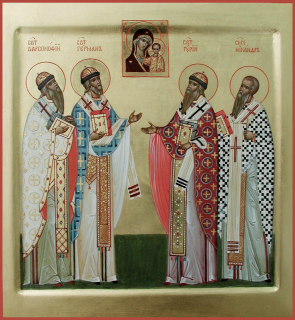
At the end of the 16th century, Kazan lived its usual life: trading was noisy, people were streaming along the streets, services were quietly going on in the monasteries. But in 1595, something happened at the Spaso-Preobrazhensky Monastery that instantly became not just local news, but an event that shook up all of Rus’.
Then, by the will of Tsar Theodore Ioannovich, they began to build a new stone Church of the Transfiguration of the Lord in the monastery. Monks and builders were digging ditches for the foundation near the altar wall of an old wooden temple — and suddenly they came across ancient coffins. This is how the relics of St. Gury, Archbishop of Kazan, and St. Barsanuphius, Bishop of Tver were found.
The news of the find quickly reached the Kazan archpastor — St. Hermogenes, a man of strict life and firm faith. It was he who, having gathered the people, decided to open the tombs. What people saw amazed everyone.
The relics of Saint Gury lay in a reliquary filled with fragrant myrrh — it was transparent, like clean water. The remains themselves seemed to rest on this world, as if on a soft pillow. The upper part of the lips was only slightly touched by decay, and the rest of the body remained untouched. Even the funeral vestments turned out to be stronger than new ones — as if they had been sewn only yesterday.
The condition of the relics of St. Barsanuphius was no less surprising. The smoldering slightly affected the legs, but the bones remained strong, without the slightest brittleness, as if time had no power over them. And his vestments also did not decay, retaining their strength and appearance.
People stood silently, afraid to break this sacred silence. Then, with prayer and chants, the relics were transferred into new arks and placed on top of the ground so that everyone could come up, bow and venerate with faith.
The rumor of the miracle quickly spread throughout the cities and villages. The Tsar and Patriarch were informed about what had happened. By their decision, the saints were soon glorified as saints. A special chapel was built in the monastery, where the relics were kept. And almost immediately news of help and healing began to arrive.
They told, for example, about the monk Joasaph: at first he touched the cancer with doubt and even with some kind of daring thought — and immediately received a burn. But, realizing his sin, he sincerely repented, again approached the shrine with pure faith — and the wound healed instantly. There were other cases: people received relief from illnesses by being anointed with the same myrrh that flowed from the relics of St. Gurias.
It is interesting that when the tombs were opened, two more ascetics were discovered — the venerable monks Jonah and Nektarios. Their bodies and clothes also remained incorruptible. With the blessing and decision of the church authorities, they were left hidden in the chapel of the monastery — where Jonah himself had previously built a memorial place over the grave of St. Gurias.
The memory of this event lives on today. The church celebrates the day of the discovery of the relicsOctober 17 (October 4, old style). And on the first Sunday after this date, with the blessing of Patriarch Pimen, a conciliar memorial is held for all the Kazan saints — so that no one forgets how the earth once revealed a great shrine to people.
Charity FundndHoly Land
Investments in Soul! News


