

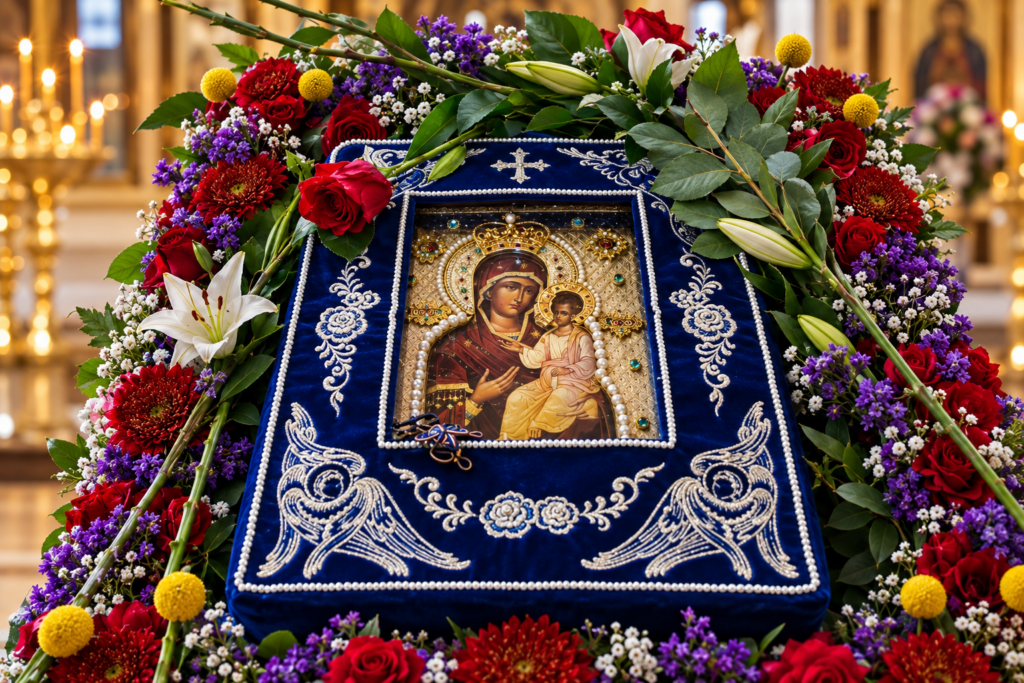
The summer of 2026 was special for Bulgarian Orthodox Christians. From July 31 to August 19, the miraculous Hawaiian Iveron Icon of the Mother of God visited the country — a myrrhic image before which prayers have been praying around the world for almost two decades. The visit was held with the blessing of the Bulgarian Patriarch Daniel, and the route of the shrine covered Sofia, Rila Monastery, Lovech and other cities. And wherever the icon appeared, crowds of people met it everywhere, queues lined up long before the beginning of divine services.
But if the pilgrimage to the temples is an expected phenomenon, then one incident in Sofia was a real shock for many.
The woman who came back to thank you
This story was told by Metropolitan Gabriel of Lovchan – not in a private conversation, but openly, after the Divine Liturgy in the Cathedral of Saints Cyril and Methodius in Lovech, where the icon was brought after the capital. According to the bishop, a woman with a severe meniscus injury was treated in one of the Sofia hospitals. The condition was serious, the prognosis was disappointing. When the miraculous image was brought to the hospital, the patient came and prayed for a long time before the icon, asking the Virgin for help.
And the next day she came back. This time, not with a request, but with gratitude. The woman felt such a sharp and unexpected improvement that she was able to come to the icon on her own. Metropolitan Gabriel did not go into medical details, but emphasized one thing: the improvement was sudden and defied the usual explanation.
Two days in Lovech.
When the shrine arrived in Lovech on the evening of August 8, it was greeted with the solemn ringing of bells. Those present immediately felt a strong fragrance — myrrh flowed abundantly from the image. The icon was accompanied by its keeper, Priest Nectarius Youngson, and Archpriest Ilia Martsev, rector of the Cathedral of St. Sergius of Radonezh in Parma, near Cleveland (Ohio). Both are clerics of the Russian Orthodox Church Outside of Russia.
For two days, while the icon was in the city, the cathedral was not empty. People came from the diocese itself, from other parts of Bulgaria, from abroad. We prayed day and night, and stood at vigils until morning.
Before the departure of the icon, Metropolitan Gabriel did what is rare: he collected the holy myrrh accumulated on the image in a special vessel. This miro will remain in the Lovchan diocese and will be used to anoint believers — a tangible, tangible reminder of those days.
Where did this icon come from?
The story of the Hawaiian Iveron Icon itself sounds like a narrative that is hard to make up.
It all started with another icon, the Montreal icon. In 1982, an Orthodox Spaniard of Chilean origin, Joseph Muñoz-Cortez, brought from Athos a list of the Iveron Icon of the Mother of God. That same night, the image began to flow. Fifteen years — from 1982 to 1997 — the icon continuously exuded fragrant myrrh. Joseph took her to the parishes of different countries, and the evidence of healings numbered in the hundreds. On the night of October 31, 1997, Joseph was murdered in Athens under mysterious circumstances. The icon disappeared without a trace.
Ten years later, on October 6, 2007, another icon died in Honolulu, on the other side of the world. An ordinary paper copy of Montreal, pasted on a board, printed in Sofrino near Moscow. The rector of the Hawaiian parish, Father Anatoly Levin, bought it in a church shop in Toronto and gave it to his parishioner, the reader Nectarius Youngson, on the name day. The icon stood for several years in the home red corner, not standing out. And then the smell of roses appeared in the apartment — first light, then persistent. Nectarius felt it everywhere: at home, in the car, at work (he served in the police). That evening, when the cat, sniffing, drew his attention to the shelf, Nectarius found that the shelf was wet, and an oily liquid flowed from the Iberian icon.
In June 2008, the Council of Bishops of the Russian Orthodox Church Outside of Russia officially recognized this miracle. Since then, the icon has traveled the world, and the flow of myrrh does not cease — stopping only for Holy Week to resume at Easter.
A keeper who doesn’t choose routes
Nectarius Youngson is a man of extraordinary destiny. A police officer injured in the line of duty and transferred to investigative work. Deacon of a small parish in Hawaii. And also — the keeper of one of the most revered shrines of modern Orthodoxy. He often says that he does not choose where to go: sometimes tickets are already bought, but at the last moment everything changes, and the icon goes to a completely different place.
It is in this way that the Mother of God determines where she is needed.
Faith and facts
The story of a woman in a Sofia hospital can be interpreted in different ways. For believers, this is another confirmation that grace does not obey the laws of medicine. For skeptics, it is a coincidence that cannot be proved or disproved. But one thing is certain: this story was not made up for a beautiful story. It was reported by the current bishop, publicly, in the cathedral, in the presence of the clergy and hundreds of parishioners.
And when Metropolitan Gabriel collected myrrh from the icon in Lovech, he did not do it from scratch. Behind this gesture stood two thousand years of tradition, fifteen years of the myrrhage of the Montreal icon, almost twenty — Hawaiian. And a woman in the hospital who couldn’t walk in the morning and came by herself the next day to say thank you.
Charity foundHoly Land.
Soul investment! News


