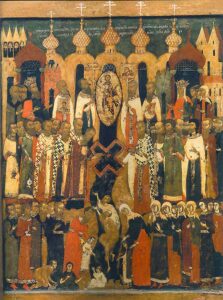
The event that took place on the Mount of Olives more than a month after theresurrection of Christ became the starting point for a new church holiday. Today it is celebrated on the 40th day after Easter, but this was not always the case.
The biblical books give divergent details of the same event.
The Evangelist Luke, in the final chapters of his narrative, focused on the moment of blessing and the departure of the Savior. In the Acts of the Apostles, the emphasis is shifted: the author is interested in the connection between the ascension and the subsequent descent of the Holy Spirit. This is where the clarification about the 40-day interval from resurrection to ascension appears.
The number 40 in the biblical tradition carries a symbolic meaning. The same number of days passed from the birth of Christ until the moment when the baby was brought to the Jerusalem temple. The same duration of fasting in the desert preceded the Savior’s appearance in public preaching.
Theologians pay attention to one detail that often slips out of sight. Ascension is not just leaving. This is the moment when human nature, assumed by Christ, was forever united with the Divine. Before his death, the First Martyr Stephen saw Jesus standing at the right hand of God, and precisely as the Son of Man. This detail emphasizes: Christ did not shed human flesh at the ascension.
Until the end of the fourth century, believers did not separate the Ascension and Pentecost. Two events were celebrated on one day — on the fiftieth day after Easter. In Jerusalem, as the pilgrim Egeria testifies, in the evening of that day everyone gathered on Mount Olivet, read the Gospel passage about the ascension and listened to the Acts of the Apostles. But the service itself remained unified.
The division occurred after the church council of 381. By that time, a controversy had arisen about the nature of the Holy Spirit. Having established the dogma of the Spirit as the third hypostasis, it was necessary to emphasize in the calendar the independence of this person of the Trinity. Pentecost became the holiday of the descent of the Holy Spirit, and the Ascension moved ten days earlier.
In the West, the new date took root more slowly. Bishop Philastrius of Brescia in the 380s also called the Ascension a holiday that happens “around Pentecost,” as if without a strict connection. But already Blessed Augustine in the year 400 writes about the “Fentecostal of the Ascension” as an ancient and universal institution.
Liturgical texts for the new holiday were created over several centuries. The earliest surviving stichera — “Thou art born, as thou didst will” — initially had nothing to do with the Ascension at all. In the 7th century Jerusalem Lectionary it is listed as a chant of the liturgy for Pentecost. Only in the 11th century, according to the Studio Typicons, did it migrate to the service of the fortieth day.
The kontakion of the holiday was written by Roman the Sweet Singer in the 6th century. In the original, it was an extensive text of two introductions and 18 stanzas, the first letters of which formed the author’s signature. The two canons that are sung today at Matins are from the pen of John of Damascus and Joseph the Hymnographer.
Modern worship retains another feature that arose by chance.
At the liturgy, three antiphons are sung — excerpts from the psalms. The opening verse is taken from Psalm 46. But the antiphons themselves today are sung from the 46th, 47th and 48th psalms. The Ascension is the only one of the twelve feasts of the Lord where the entrance verse does not coincide with the text of the third antiphon. This is a consequence of the evolution of the charter: before, other psalms were sung, but the verse at the entrance remained the same.
The holiday lasts eight days. The Ascension Day falls on Friday next week.
Memorial Day May 21, 2026
Charity FondHoly Land
Investment in the Soul! News