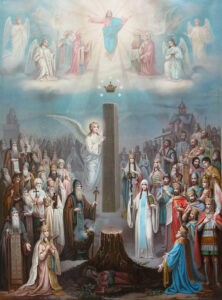
The Orthodox world is preparing to meet the Council of the Twelve Apostles
On July thirteenth, two thousand and twenty-six, believers will celebrate an important church date — the Council of the Twelve Apostles. The celebration falls on Monday and is fixed in the popular calendar under the name Polupetr, because it is adjacent to the honoring of Peter and Paul, scheduled for the twelfth.
The central figures of the holiday are the inner circle of Christ’s disciples, who received from Him the mission to carry the Gospel message. Scripture names the names of Simon Peter, Andrew the First-Called, the brothers James and John Zebedee, Philip, Bartholomew, Thomas, Matthew, James Alpheus, Judas Jacob, Simon the Zealot and Judas Iscariot. When the latter fell away from the community, the lot pointed to Matthias. The Apostle Paul, although he did not follow the Savior during the days of His earthly ministry, is revered by the Church as the supreme one — on a par with Peter.
The tradition of general commemoration of these ascetics goes back to the fourth century. At the same time, Emperor Constantine erected a temple in Constantinople dedicated to the holy envoys. After Pentecost, having accepted the gifts of the Holy Spirit, they dispersed to different parts of the world. Almost everyone completed their earthly journey as a martyr, testifying to their fidelity to their chosen ministry.
The liturgical day of July thirteenth will begin with the liturgy. In churches, fragments from the Acts and the Gospel will be read, and priests will recall the steadfastness of the first preachers. The capital’s Church of the Twelve Apostles in the Kremlin, according to tradition, will gather parishioners for a solemn service.
In peasant life, Polupetr marked the height of the harvest and the end of Peter’s Lent. The table was full of food: meat stews, fish pies, cottage cheese casseroles were prepared, and the main treat was colored eggs. The shell was given a sunny yellow hue, seeing in this a wish for light and prosperity. They were given to neighbors and loved ones.
Work in the field was not cancelled, but it was arranged in a festive manner. Mowers wore clean clothes, peasant women went out to mow in smart sundresses. In the evening, round dances were started right in the meadows, and long songs were sung. Young girls performed a ritual for their betrothed: they went for twelve flowers, placed a bouquet under the headboard and waited for a prophetic dream.
There were also strict taboos. It was forbidden to scold, boast of success, or drive away the person asking. They were afraid to remain alone, so as not to alienate them from their relatives. They did not cut their nails and hair — they believed that this could shorten their health. It was also advised to refrain from traveling long distances by water or air.
The peasants noticed the slightest changes in nature. If the bees huddled against the walls of the hives, they were preparing for the heat. The cuckoo, which did not stop talking for a long time, promised a velvety rest of the summer. A rainbow with a predominance of scarlet promised clear days, and the wind that died down in the afternoon promised a sultry evening.
Days of Remembrance
July 13
Charity FondHoly Land
Investment in the Soul! News