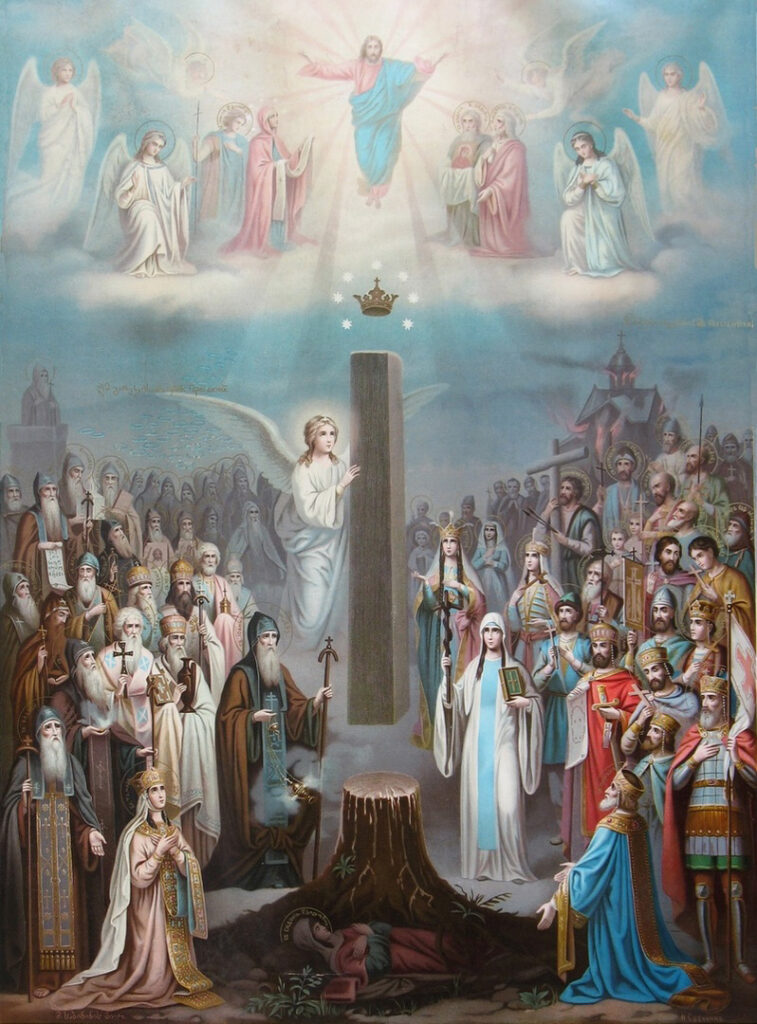
Heaton is the undergarment worn in Judea in evangelical times. According to the Gospel of John, the chiton of Christ was not stitched, but woven whole: “the chiton was not sewn, but all woven on top” (John 19:23). That is why the soldiers at the Cross did not tear it apart, but cast lots — so as not to disturb the integrity of the fabric.
For Christians, this detail is filled with symbolism. The unstitched chiton is perceived as an image of the unity of the Church: it should not be “torn”, but is called to preserve the integrity of faith and love. In church tradition, the memory of Heaton was a reminder that spiritual unity is more important than external divisions.
Traditions about the fate of the relic itself vary, and different parts of Christendom have formed their own lines of veneration. In some traditions, the emphasis was on preserving a piece of shrine, in others — on the idea itself: Heaton as a sign of the humility of the Savior, His voluntary humiliation for the sake of people. In liturgical texts and chants, the holiday emphasizes not so much an archaeological history as a spiritual meaning: Christ, who accepted human nature, walked the entire earthly path to the end, without retreating one step.
The Pillar of Life-giving: The Place Where Faith Becomes Visible
The Pillar of Life-giving is associated with the feat of St. Simeon the Stylite, a man who spent many years on top of the pillar for the sake of prayer and austerity. This image has become one of the most striking symbols of Christian resolve: to renounce comfort in order to be closer to God. The pillar here is not just an architectural detail, but a metaphor for spiritual ascent: to rise above the bustle to see the main thing.
The veneration of the Pillar of the Life-giving One in church memory is not only a memory of Simeon himself, but also of the power of prayer that can change the world. In ancient lives and chronicles it is emphasized that people came to the pillar of various classes: the poor and nobles, the sick and the doubting. And for each saint found a word, advice, prayer. Thus the pillar became the meeting place of man with God through the mediation of the saint.
In a broader sense, the pillar is called life-giving because it gave people not only healing and consolation, but also a new hope: if one person was able to rise so high in the faith, then it is available to others.
How the tradition of celebration developed
The holiday, uniting the memory of Heaton and the Pillar, was formed gradually. It combines several layers: evangelical remembrance, reverence for relics and the memory of great ascetics. In different regions, the emphasis could shift: somewhere the theme of Heaton sounded stronger, somewhere the feat of Simeon. But the general meaning remained unchanged: this is the day when the Church reminds us that earthly and heavenly things can come into contact.
In the worship of this day, texts are heard in which images are intertwined: the chiton as a symbol of unity, the pillar as a symbol of perseverance, the Cross as the center of the entire history of salvation. Prayers and chants are tuned to the inner attention: not so much to the outer details as to how these shrines can speak to the heart of modern man.
Why is memory important today?
In an era when much tends to become “fast” and “one-off,” the memory of Heaton and the Pillar sounds especially relevant. Heaton, woven whole, reminds of the value of unity — in the family, in the community, in society. The pillar of St. Simeon is that sometimes you need to stop, rise above the bustle and just be with God.
This is not a call to extremes, but a reminder of inner strength. After all, even if we can not repeat the feat of Simeon, everyone has his “pillar”: daily prayer, care for loved ones, honest work, the ability not to respond with evil to evil. And the unity, which the image of the chiton speaks about, begins with a small one: with a willingness to hear the other, not to break relations over trifles, to protect what binds people.
The celebration in honor of the Lord’s Heaton and the Pillar of Life-giving is a quiet but profound conversation of the Church with each of us. Faith is not only dogmas and rituals, but also the living fabric of life, woven of love, patience and loyalty. And in this sense, the shrines of the past continue to be “life-giving” – they give the strength to go forward without losing the main thing.
Memorial Day
October 14
Charity foundHoly Land.
Soul investment! News