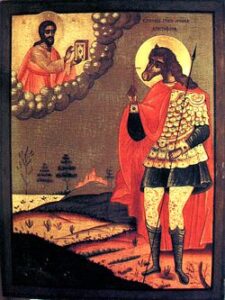
Three Lithuanian Confessors Commemorate Vilna Monastery on the Anniversary of Lost Shrines
The solemn service in the Vilna monastery of the Holy Spirit on July 26 will remind of an event almost eighty years ago. It was on this day of 1946 that the relics of the martyrs Antony, John and Eustathius, the heavenly patrons of Orthodox Lithuania, returned to the walls of the monastery after three decades of absence. Evacuated to Moscow by Metropolitan Tikhon (the future patriarch) under the threat of German occupation in 1915, the shrines were considered lost to the Baltic flock, and their reacquisition is still celebrated here as one of the key dates of the church calendar.
The history of the three passion-bearers goes back to the XIV century, to the time of the reign of Grand Duke Olgerd. At his court served two brothers from the local Lithuanian aristocracy, converted to Orthodoxy priest Nestor, confessor of Princess Maria Yaroslavna. In baptism they received the names Anthony and John. The ruler, initially favoring Christianity for the sake of political union, after the death of his wife, under the pressure of influential pagan priests, returned to idol worship.
Courtiers who remained faithful to the Gospel commandments were forced to abdicate. Both brothers refused to break fasts and participate in rituals, for which they were imprisoned by the prince’s command. Anthony endured the sentence steadfastly. John a year later could not stand, secretly promised Olgerd concessions and was released with his brother. However, external consent did not bring peace: the Christian community and even the pagan environment shunned it. Antony’s deep remorse and exhortation prompted John to repent publicly. In the face of the prince and the crowd, he loudly declared himself a follower of Christ, after which he was beaten and thrown into the same prison.
On April 14, 1347, Antony was executed by oak hanging. John, remaining in prison, continued to preach, and many visitors to the prison were baptized. The pagan magi, concerned about the increase in the number of converts, insisted on a speedy massacre. On April 24, the martyr was strangled and hung on the same tree. Both were buried in the Nikolsk temple of Vilni.
The third ascetic, Kruglets, a relative of the executed and an associate of Olgerd, was shocked by their resilience. He was baptized under the name Eustathius and began to live according to church statutes. The governor noticed that the young servant had grown long hair and suspected him to be a Christian. To a direct question Eustathius answered with a confession of faith. It happened on Friday of the Christmas fast. The prince demanded from the court to eat meat, was refused and ordered to beat the young man with iron bars. This was followed by torture in the cold with ice water, crushing the bones of the legs, peeling the skin from the head, cutting off the ears and nose. The martyr was executed on December 13 of the same year on the same oak tree. Contemporaries testified that the body left by the ground remained unharmed — neither animals nor birds touched it. Later, the honest remains were also transferred to the St. Nicholas Church.
After a while, on the site of the oak, a Trinity temple was erected. When the relics were transferred there, they were found incorruptible, and the recording of miraculous healings began. At the request of Metropolitan Alexy of Moscow and with the participation of St. Sergius of Radonezh, Patriarch Philotheus of Constantinople in 1364 sent a cross with particles of relics, confirming the general veneration of the Church. The feat of the martyrs did not pass without a trace for Prince Olgerd: at the end of his life he returned to Christianity, completing the earthly path as a monk, and all twelve of his sons were baptized.
In 1915, the shrines were taken to Moscow, and for a long time the Vilna flock said goodbye to their intercessors. The relics took their place in the Holy Spirit Monastery only on July 13 (26), 1946. The annual festive service on this date serves as a reminder not only of the tragic fate of three Lithuanian confessors of the XIV century, but also of the difficult history of preserving church relics in the XX century.
Memorial Days
27 April
The Holy Land Charitable Foundation
Lives of Saints