In the deep forests on the banks of the Obnora River, which is twenty kilometers from the modern city of Lyubim, in the XIV century, the story of one of the most revered, but little-known to the general public ascetics of the Russian north, the Monk Sylvester Obnorsky, unfolded.
Having received a blessing from the abbot of the Trinity monastery Sergius of Radonezh, the monk Sylvester left the walls of the monastery for the sake of complete solitude. His goal was to find a deserted place where he could devote himself entirely to prayer and strict fasting. Such a place was a section of dense forest on Obnor, where the hermit put a cross and built a tight cell. Tradition preserved the mention that at first the ascetic fed only bark and roots, until, according to legend, he was strengthened by an angel who appeared to him.
The solitude of Sylvester was broken by chance: a lost peasant noticed an unusual glow over the forest, resembling light rays or a pillar of cloud. Soon the news of the deserter spread to the surrounding villages, and people seeking spiritual advice reached his cell. When the number of people wishing to settle next to the hermit increased, Sylvester went to Moscow to Metropolitan Alexy for a blessing to build a church. Thus the Resurrection Monastery arose on the bank of the Obnor, where the monk became the first hegumen. Subsequently, these lands were glorified by his followers — Pavel Obnorsky and Sergius Nuromsky.
Despite the leadership of the brethren, the craving for solitude did not leave Sylvester. He regularly left the monastery, going deep into the forest. This area of the forest received the status of a “preserve grove”. The saint personally dug four wells there and strictly ordered the locals not to cut down trees here. Violation of the ban, according to legend, was severely punished. In the middle of the XVII century, the builder of the monastery, Hieromonk Job, decided to use wood from the grove for household needs, but suddenly became blind. But he did not receive the Holy Spirit until he repented. Since then, the covenant of the saint was not violated even in the Soviet years.
The life of the ascetic ended on April 25, 1379. According to legend, before his death, he urged the brethren not to be afraid of temporary misfortunes, promising that the place of his exploits would not be impoverished. The remains of the saint were buried to the right of the wooden Resurrection Church. In the XIX century, several signs were recorded, including reports of the incorruptibility of the relics, which attracted a stream of pilgrims to these parts.
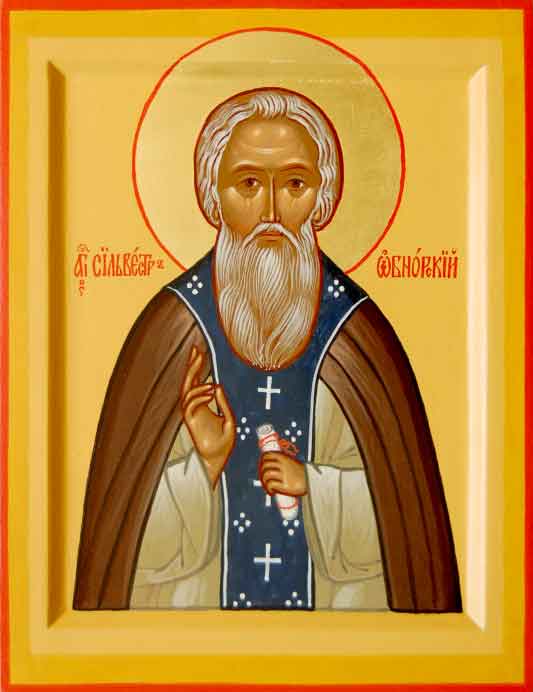
Despite the fact that the detailed life of the saint died in a fire at the end of the XVIII century, his image was preserved on icons. Traditionally, Sylvester is depicted holding a scroll with part of his spiritual will, which refers to the preservation of the commandments and the fear of God. Today, after many years of desolation, divine services in these places are resumed, and on the day of the saint’s memory, May 8, a procession is still made to the protected grove.
Memorial Days
May 8
June 5— Cathedral of Rostov-Yaroslavl Saints
July 11 (transient)— Cathedral of Vologda Saints
July 19— Radonezh Saints Cathedral
The Holy Land Charitable Foundation
Lives of Saints