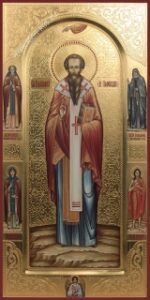
At the beginning of the fourth century, the Pontic city of Amasia was at the center of the confrontation between the church hierarchy and imperial power. The local bishop Basil was executed by personal order of Licinius, co-ruler of Constantine the Great, who ruled the eastern provinces. The formal reason for the massacre was the sheltering of a fugitive maid of the imperial court.
Licinius went down in history as a ruler who signed an edict on freedom of religion, but in practice maintained hostility to Christians. His conflict with the Amasian bishop began with a seemingly domestic episode. The governor became interested in Glaphyra, a girl from among the servants of his wife Constance. She was a Christian and refused. Moreover, she reported harassment to the mistress.
Further developments developed rapidly. Constance organized an escape: the girl was dressed, given funds for the road and secretly taken out of the residence. The emperor was told that the maid was seriously ill. Glafira went to Armenia, but on the way stopped in Amasia. The bishop granted her asylum. The girl, learning about the construction of the church, gave all the money available for these needs and wrote a letter to the queen asking for additional funding.
The message was intercepted. Licinius, discovering that the fugitive was alive and under the protection of the church, ordered the ruler of Amasia to extradite them immediately. Glafira had already died by the time of receiving the decree, so only the saint was taken into custody. Basil was sent to the capital accompanied by two deacons, Parthenius and Festima. The prisoner was also regularly infiltrated by Elpidifor, a local wealthy Christian who paid for night visits.
Licinius put forward the condition: Basil passes into paganism and heads the priestly college. In return, the high status and patronage of the court. The bishop rejected the deal. A death sentence followed. Before the execution, the friends of the saint managed to arrange for him a final prayer and farewell. Vasily himself, according to legend, remained calm and turned to the executioner himself, urging him to fulfill the order.
The remains of the deceased were thrown into the sea. But Elpidifor did not give up: according to him, an angel appeared to him three times in a dream and called the city of Sinop the place where one should look for the body. Together with the deacons, he went there. Fishermen threw their nets twice; a second attempt, at the request of a Christian, brought the body. On the neck of the deceased remained only a trace of the sword, the head was connected to the body. The relics were returned to Amasia and buried under the vaults of the temple, which began to be built with the participation of Glafira.
The days of the remembrance of the Hieromartyr fall on May 9 and 13 according to a new style: the first is associated with the date of the execution, the second with the acquisition of the remains.
Memorial Days
May 9
13 May— Finding relics
The Holy Land Charitable Foundation
Lives of Saints