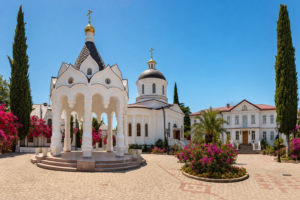
The history of this monastery is inextricably linked with the history of the Don Army. The Cossacks came to the outpost of the Russian state, to the uninhabited steppe lands. The task was to develop the land and protect the borders. This is not an easy matter; there were many wounded and maimed Cossacks. And so they began to settle in a private place, away from people. They prayed, fasted, and built cells for themselves. And by 1652 they asked Patriarch Nikon for permission to open a monastery. They built a wooden church, but bad luck — during a high flood the bank was washed away and all the buildings collapsed. We had to move the monastery further away and build everything anew.
In 1785, the monastery was converted into a convent. But the nuns did not live there for long. During the time of Catherine the Great, the monastery was closed. The nuns went to Kyiv and prayed incessantly for 10 years for an opening. Under Paul I the monastery was reopened. 40 girls from the Orphan
meeting were placed there.

The real heyday of the monastery came at the end of the 19th century, under the abbess Mother Arsenia. Elder Anthony saw Mother as a child and predicted that she would have an unusual fate. And so it happened. Mother Arsenia asked permission to build a new church in the monastery in honor of the icon of the Kazan Mother of God. The building was designed by Ivan Gornostaev, a member of the Academy of Arts. The temple turned out majestic, snow-white, filled with light. As the building grew upward, Mother Arsenia dug down the cave temple complex. According to her idea, the caves were supposed to symbolize the way of the cross of the Savior and the passionate path of the Virgin Mary. The main shrine of the cave complex is the Monk’s Stone. According to legend, one night the abbess had a vision. She saw 2 clouds. In one, the Mother of God stood on a stone and prayed on her knees. In another she saw the building of a finished temple. When
Arsenia woke up, a stone with traces of knees and palms was in front of her. This stone attracts a lot of pilgrims even today. Even on the secular website tripadvisor.ru there is evidence of wish fulfillment through prayers in front of the stone. It especially helps childless families.

The fate of the monastery is tragic. It was closed in 1928. The nuns organized a commune and secretly led their lives according to the Rule. During the war there were fierce battles on the banks of the Don. Buildings and structures were badly damaged. After the war, the Kazan Cathedral was used as a warehouse, and other premises were used as a children’s camp.
The next revival of the monastery began in 1992. The monks took on the difficult task, but after 10 years the monastery again became a women’s monastery.
Gradually the monastery was revived. The Kazan Cathedral was restored. It was decorated with a marble iconostasis. 10,000 people gathered for the lighting.
There is also a new Church of the Transfiguration of the Lord in the monastery. It is an exact copy of such a church in Kizhi. 33 domes symbolize 33 years of Jesus’ earthly life.
The belfry in the monastery is very unusual. It looks like an arch and is part of the wall of the old Church of the Transfiguration of the Lord, which was blown up in 1934.
There is a pilgrimage center at the monastery. The nuns cordially welcome pilgrims, and they, in turn, lead a life typical of the monastery: they participate in divine services and labors.
Charitable Foundation Holy Land
Temples and Monasteries of Russia