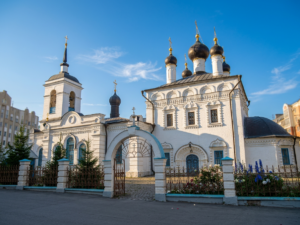
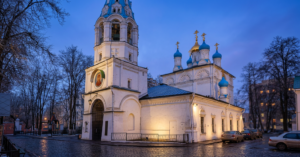
The trading side of Veliky Novgorod keeps the memory of those times when the local air was saturated with the aromas of overseas wax and viscous honey. Amid the noise of the ancient market, near the Yaroslavov courtyard itself, stands a low, but surprisingly tenacious temple. It is as if it sprouts from gray limestone soil, for which it received its nickname “on the Opoks”. Within its silent walls is encoded a drama that spans nine centuries.
Imagine the year 1127. The great-grandson of the Byzantine princess, Prince Vsevolod Mstislavich, lays the church not just for prayer, but as a daring manifesto of power. In just three years, the construction is completed, and the temple immediately acquires a special status. The prince handed it over to the community of merchants. This was not just a gesture: here, under the vaults of John the Forerunner, wealth was settled, a commercial court was held and control weight standards were stored. Business and faith are intertwined.
However, time does not spare even stone giants. By the middle of the XV century, the building was so dilapidated that Archbishop Euthymius II made a radical decision. In 1453, the ancient walls were ruthlessly dismantled. But, surprisingly, the masters do not seek to erase the past: the new temple is literally put on the foundation of the old, preserving in the lower masonry the memory of the princely plan.
The appearance of the church is ascetic and noble. This is a cross-domed composition with three apses, made of flat plinth, which even centuries later keeps the warmth of the hands of ancient architects. Particular ease to the harsh facade gives arcature-column belt — as if petrified lace, characteristic of Novgorod architecture of the pre-Mongol era.
In the twentieth century, the temple passed a real hell. First, in 1934, the bell tower was dismantled. Then, in the war, a fiery death came here: fascist shells demolished the drum and the dome, turning the northern wall into a sieve. The story seemed to end there. But in the 1950s, restorers performed a miracle, bringing the shrine back to life.
And more recently, in the summer of 2023, the land made a sensation. St. Petersburg archaeologists, having opened the cultural layer, came across dazzling fragments of fresco painting of the 1130s. Under the feet were hidden the remains of the stair tower and even the masonry of the very first cathedral of Vsevolod. It turns out that the temple has not yet told half of its secrets, forcing us to listen to its stone breath.
Charity FundHoly Land.
Russian Temples and Monasteries