Steppe can keep silence. But in Katzbach, this silence once split — and since then, every Sunday over the treacherous expanses, the bell rings. Not loud, but stubborn.
As tenacious as the village itself, its inhabitants and a wooden church that neither the officials with mandates nor decades of oblivion could destroy.
Katzbach is a place that is not written about in guidebooks. There are no crowds here. But it was here, on the land of Kizil, that a single wooden temple was preserved – a living testimony to the fact that some things survive everything.
The Cossack village was built thoroughly. The Kalmyk Cossacks who settled here knew how to do something with their own hands for centuries — and the church was built with this calculation. Material selected
unmistakably: larch. A tree that grows stronger over time, almost turning into stone. They were built without metal fasteners — according to an old tradition, when the skill of a carpenter was valued higher than the stock of nails.
The construction stretched from 1893 to 1904. The money was collected by the whole world — they gave as much as they could. The consecration took place at the beginning of the XX century, and from the bell tower for the first time sounded the bell ringing, specially tuned to reach distant farms. The craftsmen who cast the bells possessed a rare secret of resonance — their work sounded different from ordinary casting.
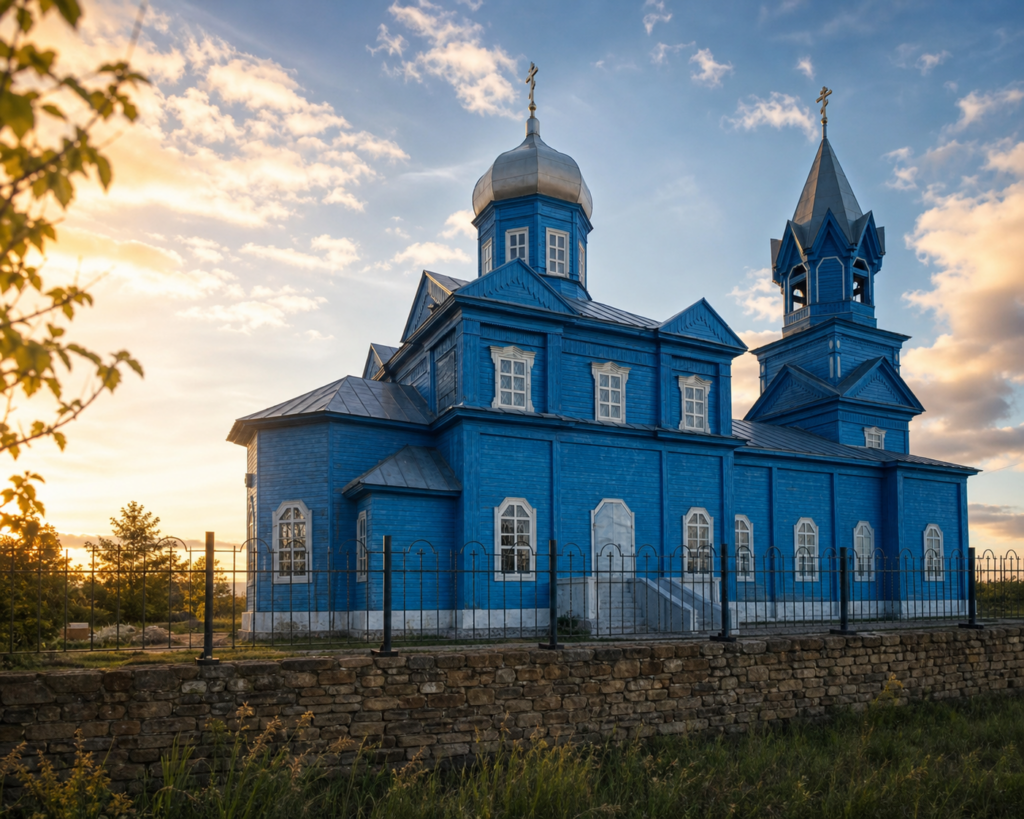
In architectural terms, the temple was built according to an exemplary project — so in the Synodal era the approved model drawings for provincial churches were called. But typical — does not mean faceless: one-headed four with two tiers of windows, a spacious refectory, tented bell tower.
It’s all clear, nothing superfluous. The sky-blue color of the walls is not a random whim, but a conscious choice, thanks to which the building is noticeable against the background of the brown steppe at any time of the year.
Soviet power reached Katzbach in the early 1930s. Priest Nikita Dudakov was arrested. The domes were dismantled, the crosses were thrown into the river, the bells were taken away for melting.
The iconostasis and utensils were burned right in the yard. In the walls where the prayers used to be read, they are now kept
They put out fires and danced.
The building survived — thanks to the same larch that was chosen a hundred years ago.
Revival did not begin on orders from above. Local residents themselves took up logs and boards, collected money themselves, went to the construction site together with the hired craftsmen. By 2005, the church was once again what it was intended to be: a sheathed tree painted blue, with gilded crosses and four new bells on the belfry.
The first service took place in April of the same year. They say that almost everyone who was in the village came.
Charity FundHoly Land.
Russian Temples and Monasteries