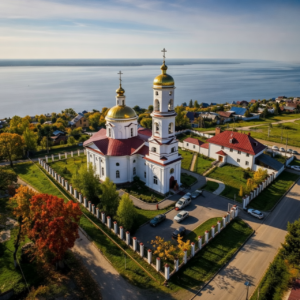
Imagine: noisy, fast-paced Yekaterinburg, and in the middle of this rhythm – an island of silence and history, where every brick breathes the XVIII century. The Ascension Church, known to the townspeople as the “Three Seen Candle”, stands at the crossroads of time. A rare case when the temple seems to control its age: it does not decrepit, but with dignity carries through the years Baroque stucco and human destinies.
Its history began modestly: in 1770, a tiny wooden church was consecrated here. But the tree on the Ural land is short-lived, and by the end of the century the community planned a grandiose stone chronicle. So, in 1792, the foundation laid the first brick, laying the future greatness. The lower chapel, consecrated in 1801 in honor of the Nativity of the Virgin, became the heart of the complex, and the upper, Voznesensky, rushed into the sky, completing a slender two-storey four. The project was worked by the architect A. Kichigin, whose handwriting is guessed in the elegant lines of the late Baroque.
The temple was completed by the whole world for almost a century. By the middle of the XIX century, it had acquired side aisles and a multi-tiered bell tower according to the project of 1836. By the beginning of the XX century, six thrones were buzzing here, and at the bottom, right under the vaults, children’s voices rang: a parish school was located. It always seemed that way.
But it was 1926. The temple was closed. First, lessons were taught in the prayer walls, then exhibits of the historical and revolutionary museum were placed. Where prayers have been heard for centuries, museum silence reigned for a time. Revival began only in 1990, when the building was returned to the faithful. Restorers led by O. G. Vostretsov returned to their former splendor, and on February 15, 1991, the first liturgy in 65 years sounded here.
Today, this place surprises with the neighborhood of traditions. Since 1995, in the Kazan aisle of the upper church, the Old Believers – descendants of the Ural chapels – pray. Their quiet singing organically intertwines with the main Orthodox service, creating an amazing spiritual unison. Thus, the Ascension Church became a living bridge between eras and confessions, where everyone will find a response — whether it is a strict note of baroque or a warm light of the iconostasis.
Charity FundHoly Land.
Russian Temples and Monasteries