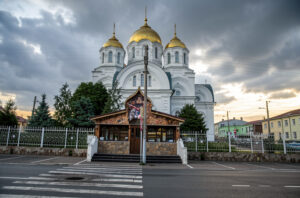
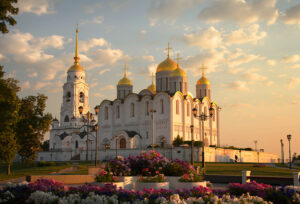
There are places where time does not flow, but shrinks. A small church on Bolshaya Krasnoflotskaya Street does not outwardly stand out among the Smolensk buildings. But it is worth noting that these walls stood here even before Smolensk first saw the Mongol army, and the view of it changes.
The Church of John the Theologian is the same age as the European cathedrals of the Roman era. While the Gothic spires were being erected in France, the Smolensk prince Roman Rostislavich built a brick church on the Dnieper hill — a family, memorial, ceremonial one. It was not just a place to pray, but also a school where Greeks and Latins taught. This principality is not exactly provincial.
The plan was solid from the beginning. In contrast to many modern buildings that
Gradually overgrown with galleries and chapels, the St. John’s temple was built immediately in full.
Volume: with side aisles and a tripartite gallery-tomb. The prince knew exactly what he wanted: places where his family would pray and where he would find peace after death.
The chronicle is stingy for details, but eloquent: the temple was decorated with gold and finifty — a special technique of enameling on metal. This was not just a demonstration of wealth. It was the language of the age that spoke of the eternal.
Then another story began, a long and brutal one. In 1611 Smolensk fell after a two-year siege. Polish King Sigismund III entered the victorious city and the Orthodox Church became a Catholic church. More than forty years passed before everything returned to normal: Tsar Alexei Mikhailovich returned the church to the Orthodox and allocated money for the iconostasis.
The eighteenth century did not bring war, but something worse for architecture: a well-intentioned restructuring. By that time, the vaults had collapsed, meters of debris had accumulated inside. Restoring the church was undertaken vigorously, but without looking at the original: the floor was raised almost two meters, the upper part was rebuilt, the facades were fashionable then. Then Napoleon came. Then Soviet power. Then the Germans — and from the bell tower with the refectory there was nothing left.
Today, the church is a cross section of several centuries. The lower parts of the walls are the true XII century: plinth on a cobblestone base, corner crosses of brick. Above — the restructuring of the XVIII century.
The original floor is somewhere out there, in depth, almost two meters below the current one.
Fragments of frescoes survived, as if the pages of an old book had not accidentally burned down.
An interesting detail: in 1958, thirty meters from here, the remains of a round church of foreign merchants – the “German Virgin” were found. It kept the official city weight standard.
The trading quarter and the princely temple were almost close to each other.
In 1993, the building was returned to the churches. There was a warehouse inside. The temple was restored for several years — at the expense of the region, local business and parishioners. In May 1995, the temple was consecrated.
Outside the Dnieper window. On the hill there are walls that are more than eight centuries. They have seen so much that our time seems to them to be just one short chapter.
Charity FundHoly Land.
Russian Temples and Monasteries