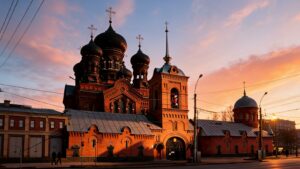
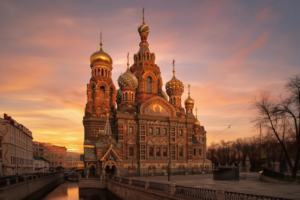
It’s amazing how a small church in a Russian city can make a huge difference to the world. Who would have thought, when the Church of Savior was founded in 1374, that it would become a World Heritage Site? We do not know exactly who invited the Byzantine Theophanes the Greek to paint the temple, but we know that he saved the frescoes of the famous artist for the whole world. No other works of Theophanes have survived anywhere.
The streets clearly loved the lush decor — the church, strict in architecture, is decorated unusually magnificently. Numerous arches, ribbons, crosses on the entire facade soften the strict, cross-shaped silhouette. There is a version that the crosses are laid out in memory of those who died in the battle for Torzhok Novgorod.
The painting of the temple was repeatedly cleared, freeing it from whitewash and plaster. This was done under the Tsar and under Soviet rule. The frescoes are preserved only in the form of individual fragments, but they also give an idea of the talent of the master. The painting is monochrome, the artist used different shades of red and brown to create piercing paintings. There are few details, but the general impression does not leave anyone indifferent. About the manner of work of Theophanes we know from the letter of his contemporary, scribe and philosopher Epiphanius. He told his friend that Theophanes never looked at the sample, wrote playfully. He could talk while working, and his hands seemed to know what to do.

The frescoes are best preserved on the dome and drum. A majestic figure of the Savior. He is surrounded by archangels, cherubim and seraphim. Under the angels are depicted forefathers, which is quite unusual for that time. Theophanes preferred to depict not the prophets, but the forefathers: Adam, Melchizedek, Noah, Abel. There are only 2 prophets: Elijah and the Forerunner.
The church itself was not rebuilt, but it had extensions. First, the porch and the little belfry. Then, in their place built a warm papert with a bell tower. These extensions were dismantled in 1936.
The exterior painting of the temple was created much later, but, oddly enough, they learned about it by accident. In 1831, during a cholera epidemic, a huge piece of plaster fell off the wall. Under it was found a fresco with the image of Our Lady Odigitria. As soon as it happened,
The epidemic has gone down. On the southern facade, the image of Our Lady “The Sign” is preserved.

The ancient temple has repeatedly suffered from invasions and fires. The frescoes were washed with alkali, and at some point simply whitewashed. During the war, there was a German observation post in the temple. They drowned the bourgeois, soot badly damaged the painting. As if that were not enough, a shell hit the building, causing significant destruction.
Even the Soviet authorities recognized the value of the frescoes. Attempts to clear them were made at the height of the civil war, in 1918. After the Patriotic, the temple was restored, annexes were removed, soot was cleaned. Researchers do not exclude that somewhere under lime and plaster, other works of Theophanes the Greek are waiting for their time.
Now the building is a museum, where guides are happy to tell about the history of the temple and its unusual frescoes.
Charitable Foundation Holy Land
Russian Temples and Monasteries