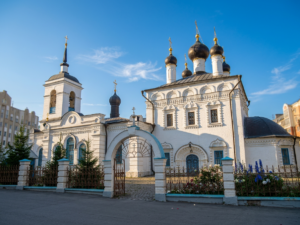
There are few examples of architecture preserved before the Mongolian era, and in Smolensk there are as many as 3. One such example is the temple of Peter and Paul. It was built in 1146 as a house church for the Smolensk prince Rostislav. From the princely chambers in the building laid a special passage directly into the prayer room. The prince prepared for his last resting place funerary niches — arcosolia, but went to prince in Kiev, died and was buried there. The temple became worldly, the passage from the princely chambers was laid in it. The outer walls of the temple were decorated with figurework. Inside they were painted with frescoes, fragments of which were found during the restoration of the 20th century. The walls of the temple are covered with graph fiti, the study of which no one seriously conducted.
So far, only one inscription has been deciphered — Vasily Usov’s request to the Lord for help. Yes, some student practiced the alphabet on the wall, but did not go beyond the 6th letter. The floor of the church was first laid out with brick, and then with beautiful majolica tiles. Samples of it were preserved at the altar.

In 1404, Smolensk fell to the Grand Duchy of Lithuania, and 100 years later returned to Russia, to another 100 years later, in 1611, fall under the rule of the Poles. Unlike the Lithuanians, the Poles showed no tolerance for Orthodoxy and the church became a Catholic church.
Shortly, only for 7 years, Bishop Sergius of Smolensk won the right to perform Orthodox services in the church. Then, in 1625, the Uniate Archdiocese was formed.
Worships were Catholic, but carried out on the Greek model. Orthodox worship resumed in 1654, when the city returned to Moscow.

In the middle of the 18th century, 2 grand staircases were attached to the bishop’s chambers, a bell tower was erected, a church was built over the chambers, which was consecrated in honor of the Great Martyr Barbara.
In 1812, the French set fire to the church. Dry tree flooring and finishing burned so hard that the bells melted. The building was restored for more than 20 years, at the expense of parishioners.
After the revolution, the building was transferred to the museum, services were held in the church of St. Barbara. For a short time they resumed in the Peter and Paul Church. The church was finally closed in 1935, and Archbishop Seraphim of Smolensk was arrested as an enemy of the people. He was later shot.

The church, badly damaged during the Patriotic War, began to be restored to the celebration of the 1100th anniversary of Smolensk, in 1962. As a result, the building was returned to its original appearance.
In 1991, the temple was transferred to the jurisdiction of the Russian Orthodox Church. Now it is part of the temple complex, which includes the Church of St. Barbara and various temple buildings.
Orthodox pilgrims are attracted to the temple by icons:
Our Lady of Iver, brought from Athos
Saints Peter and Paul
Nicholas the Wonderworker
Holy Prince Rostislav
In 1993, Patriarch Alexy II presented the icon of the Mother of God “Kazanskaya” to the Peter and Paul Church.
Charitable Foundation Holy Land
Russian Temples and Monasteries