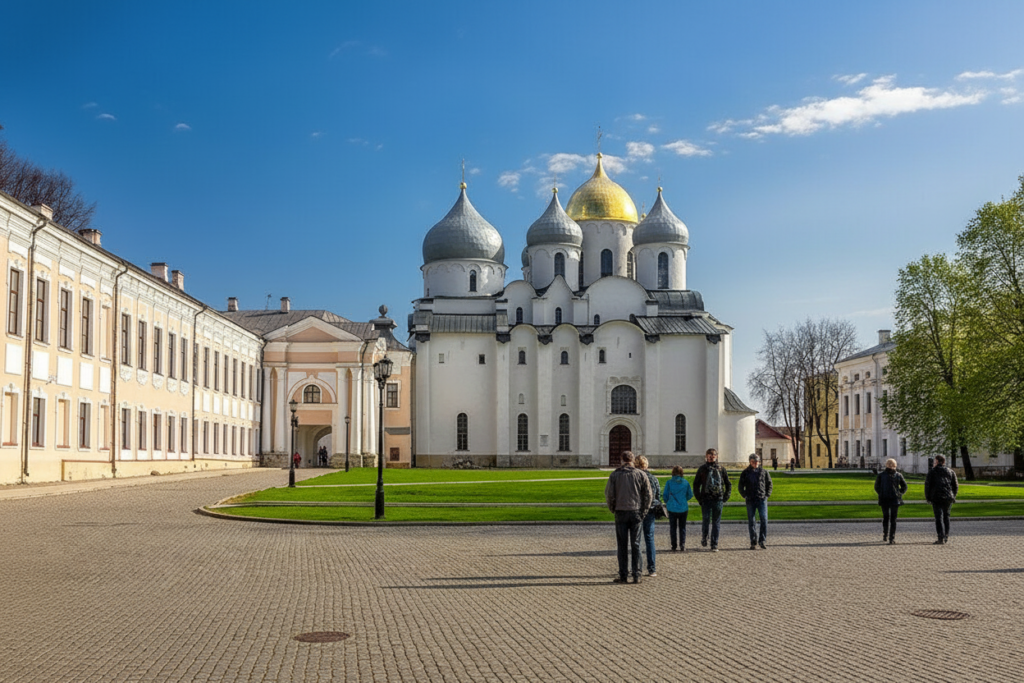
“Where St. Sophia is, there is Novgorod” – 900 years later, these words still echo in the hearts of Novgorodians. Never before has the temple been so associated with the city as St. Sophia Cathedral. It was built by Prince Vladimir, the son of Yaroslav the Wise in 1050. The masters were invited from afar, but the Byzantine and Kiev architects managed to convey the character of Novgorod in this temple: powerful, slightly harsh, restrained, but capable of great plans.
Novgorodians were sure that St. Sophia saved their city from the invasion of the Mongols, protected from the sea wind, helped to withstand the Polish invasion. He saved the strangers, and he did not save his own. When Ivan the Terrible captured the city, he was brutally looted. There’s a legend to this. Allegedly, during the robbery, a dove sat on the cross of the church and petrified from the horror that was happening below.
During the fascist occupation, the cross was removed from the cathedral and taken away. After a long search, it was found in a Spanish museum. Only in 2004 he was returned to his homeland. It is stored inside the cathedral, and a new one is installed on the roof.
Another legend is associated with frescoes inside the cathedral. The image of Christ on the dome was conceived with an open hand, but it could not be written out. After many attempts, Christ appeared to the artist in a dream, who explained that he was squeezing his hand because he was holding Novgorod in it.
The temple was painted in several stages, sometimes covering the old frescoes with new ones. Only a small part of the painting has reached us. One of the murals is very unusual. The fact is that the figures of Saints Constantine and Helena are written in a very unusual technique – on dry plaster. Copy that.
It is believed that this technique was used in the painting of Russian wooden churches, but they did not reach us. But the fresco in Hagia Sophia has survived.
The main, Magdeburg Gate is opened in the temple only on holidays. They were captured as a military trophy during clashes with the Swedes, brought and installed in the temple in the 12th century. In the 15th century, the Russian craftsman Abraham renovated the gates and now his name is written on them, along with the names of German masters Rickwin and Weismuth.
The main shrines of the cathedral:
The icon of the Mother of God “The Sign” was painted in 1070. She has survived numerous wars and struggles with religion and is preserved with reverence in her native cathedral.
Tradition says that it was she who saved the Novgorodians when Andrei Bogolyubsky wanted to capture the city for Suzdal. The icon was carried out on the walls, and an enemy arrow pierced it. Tears flowed from the eyes of the Virgin, and madness attacked the Suzdals. They began to fight with each other, the Novgorodians easily turned them to flight.
Our Lady of Tikhvin. After the liberation of Novgorod from the Swedes in 1617, it was necessary to sign a settlement agreement. The ambassadors went to pray to the Mother of God Tikhvin, who protected the monastery from invasion. They took one of the icons with them. Our Lady did not leave Novgorod, a treaty was signed in Stolbovo.
The peacemaker welcomed the whole of Novgorod with a procession, and the metropolitan carried the icon in his arms until he installed it for worship in the St. Sophia Cathedral. Tsar Fyodor Mikhailovich even ordered to celebrate a holiday in honor of this event.
The Assumption of the Blessed Virgin is a list from the icon from the Kiev-Pechersk Lavra. It was written as a gift to the Sophia Cathedral. In the salary put the relics of St. Nifon, Metropolitan of Novgorod in the 12th century, a famous builder of temples. In 1941 she was taken with her by believers who were evacuated from Novgorod. This icon is prescribed a miraculous rescue of the train with the evacuees during the carpet bombing by the Nazis.
The cathedral also contains the relics of St. Prince Vladimir Yaroslavich, who ordered the construction of St. Sophia, his wife Anna, Holy Prince Fyodor Yaroslavich, Holy Prince Mstislav (George) the Brave, St. John and Nikita.
Sophia Cathedral is an active temple. Divine services are held there 2 times a day, but the Sacraments of Baptism and Funeral are not performed.
There is a Sunday school and a library.
Charitable Foundation Holy Land
Russian Temples and Monasteries