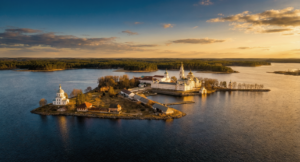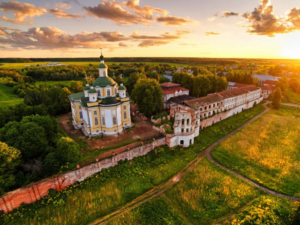
If you drive north from Vologda along the old road, past Gryazovets, past villages with chimneys and vegetable gardens, the asphalt gradually becomes thinner, the forest thickens, and somewhere there, around the bend, near the small Nurma River, a view of white walls and domes opens up. This place seems too quiet for what has happened there over seven centuries. Here they prayed, burned, looted, restored, burned again, restored again. And they still stand — the walls, the temple, the memory.
The Man from the Hollow
It all started not with the temple and not with the wall. It all started with one person who needed silence. The Monk Pavel Obnorsky, a disciple of Sergius of Radonezh, came to the Komel Forest at the end of the 14th century. The forest was deaf, bearish, without roads. Pavel found a linden tree with a hollow and lived in it for three years. Not in a hut, not in a cell — in a hollow tree, near the Gryazovitsa River. He ate what the forest provided: herbs, roots, berries. At first, local peasants were afraid — they thought he was a forest person, unclean. Then they realized: a saint.
Three years later, Pavel moved to the Nurma River — even deeper into the forest. He built a cell and dug a well. Others began to come to him — those who were also looking for silence. Having received the blessing of Metropolitan Photius, Paul erected a wooden Trinity Church. So a monastery grew up around a tree with a hollow.
Paul established a strict communal rule for the brethren: everything is common, nothing of their own, prayer and work from dawn to dusk. He entrusted management to a student, Alexy, making him abbot. Paul himself went even deeper into the forest — into a separate cell, half a kilometer from the monastery. He came to the brethren only for services.
On the tenth of January 1429, the Monk Paul died. In 1457 he was canonized. The relics became the main shrine of the monastery — and the main reason why the monastery was then robbed, burned and destroyed.
Stone instead of wood
For a long time the monastery remained wooden — as befits the northern desert. The tree was cut down, it burned, it was cut down again. But at the beginning of the 16th century something happened: Grand Duke Vasily III — the son of Ivan III, the father of Ivan the Terrible — took the monastery under his guardianship. From 1505 to 1516, the stone Trinity Cathedral was built. For the northern wilderness, this was an event of unimaginable scale: a stone temple in the forest, near a river, in a village that is not on the map. But Vasily III knew what he was doing: the monastery stood on the northern borders, and the stone fortress-temple was not only a house of prayer, but also a stronghold.
In the 16th century the monastery became rich. Lands, lands, donations. But wealth attracts not only pilgrims. In 1538, the Kazan Tatars came with a raid, plundered the monastery and burned it. The wooden buildings burned down, the stone cathedral survived, but was damaged. The brothers scattered. It seemed that was all. But the monastery was raised again.
The river that was turned back
In the 17th century, the monastery was rebuilt. A bell tower and a monastery fence appeared. But there was one problem: the Nurma River. It flowed right next to the walls and washed away the foundations. Every year there is a spring flood, water is at the walls, the ground is swimming, the masonry is cracking.
In the middle of the 19th century, the problem was solved radically: the river was turned. They dug a canal, took Nurma to the side, and used the dry riverbed—old, winding, with clayey banks—for a vegetable garden. The monks grew cabbage and potatoes there. On the right bank of the new riverbed, by order of the abbot, spruce and pine groves were planted. The groves are still growing — tall, dark, rustling in the wind.
In 1863–1866, the monastery was surrounded by a three-meter stone wall with four towers. The wall was not built for beauty: the northern forests were not always safe. In 1881–1887, a four-tier bell tower with an onion dome was erected — high, visible for many miles. By the beginning of the 20th century, there were four churches, two fraternal buildings and a three-story abbot’s building inside the fence. In 1904, an icon painting school was opened in the abbot’s building — the monks learned to paint icons, and the school was one of the few in this wilderness.
To the west of the monastery they built a hill — a truncated cone of earth and sand. They called it «Calvary». An octagonal wooden chapel was erected on the top in 1867–1869. The hill still stands, and if you climb it, you can see the entire monastery — walls, domes, a grove, a river, fields beyond the river.
Two fires
In 1767, there was a big fire in the monastery. The wooden buildings burned down, the ancient iconostasis perished — the same one that had stood since the time of the first stone buildings. It took a long time to restore.
And on the night of August 25-26, 1909, it caught fire again. The fire was strong and destroyed part of the buildings. But it was after him that something unusual happened: Emperor Nicholas II and Tsarina Alexandra Feodorovna personally allocated funds for restoration. A silver shrine with a marble canopy was built over the relics of St. Paul — heavy, elegant, with chased patterns. The shrine stood in the Trinity Cathedral, and pilgrims from all over Russia came to it.
End and Beginning
In 1920 the monastery was abolished. The monks were expelled — some went into the world, some into a camp, some into the forest. In 1924 the monastery was closed completely. And then began what always begins in such cases: devastation. Trinity Cathedral was blown up. The bell tower was dismantled — the bricks were used for construction, roads, and farms. The fence was pulled away over the stones. Four towers were gone. The silver crayfish disappeared — maybe it was melted down, maybe it was sold abroad. What happened to the relics is unknown. In the premises that survived, an experimental pedagogical station was placed, then a school, then an orphanage, then a boarding school. The territory was renamed the village of Yunosheskoye — as if the monastery had never been here.
The trees in the grove grew. The well that Paul himself dug was overgrown with grass. «Golgotha» — a bulk hill — was covered with bushes. The chapel at the top fell into disrepair, but survived. Nurma flowed along a new channel, indifferent to what was happening on the shore.
Return
In 1994 — seventy years after its closure — the monastery was returned to the Church. At first it became a courtyard of the Spaso-Prilutsky Monastery: one of the senior monasteries of the Vologda diocese took the younger one by the hand. On December 27, 2003, the Pavlo-Obnorsky Monastery became independent.
Hegumen Amphilochius became the first abbot. He did not come to a finished monastery — he came to ruins. The refectory church in the name of the Dormition of the Mother of God, the lower tiers of the old bell tower near the eastern wall, and part of the abbot’s building survived. On June 5, 1998, Archbishop Maximilian of Vologda and Veliky Ustyug consecrated the refectory church, and prayer began to sound in it — for the first time in seventy years.
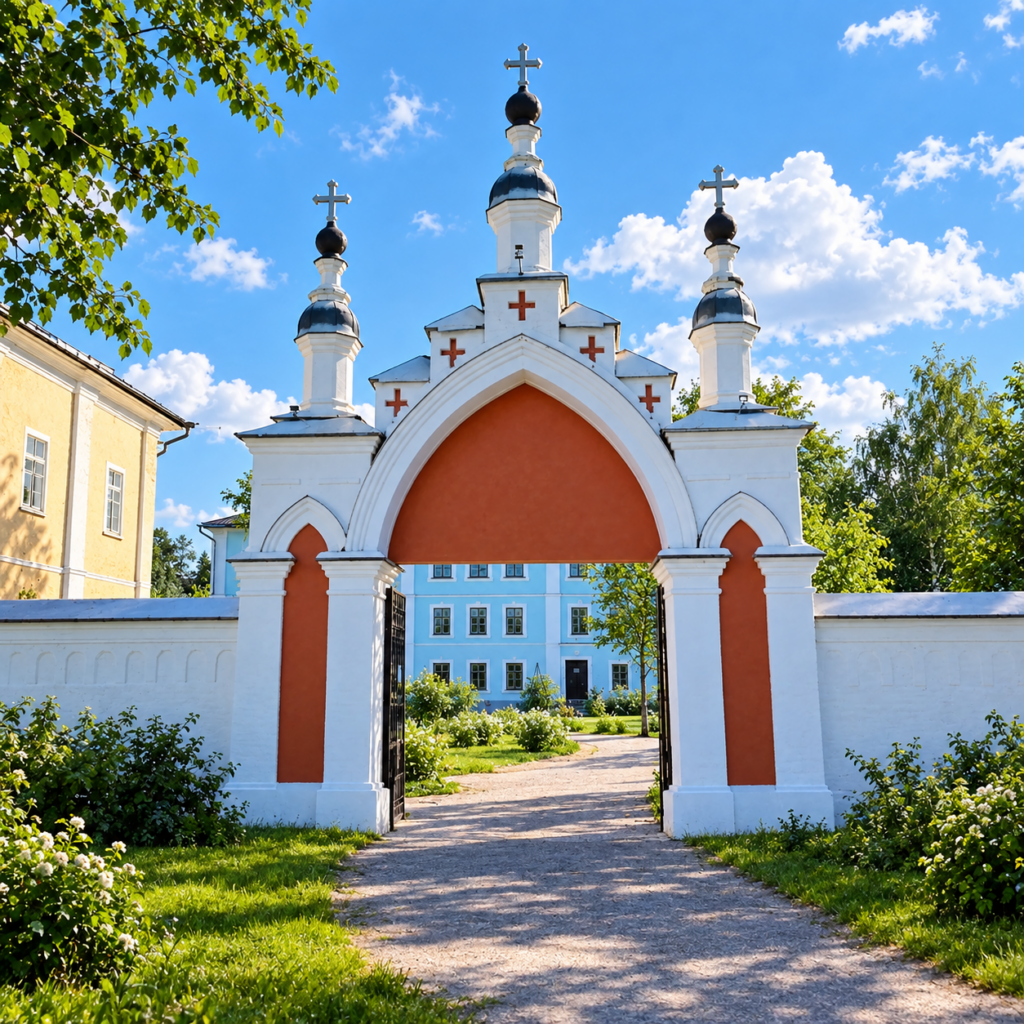
Hegumen Amphilochius and the brethren — not numerous, at first literally just a few people — and with the support of benefactors, they did what seems impossible: they restored the surviving buildings, erected part of fence with the Holy Gates, they built a wooden bell tower — not the one that was blown up, but a new one, more modest, but ringing. They erected a chapel over the resting place of the relics of St. Paul. They started an apiary, equipped a carpentry workshop, and organized a subsidiary farm. The monastery began to live again — not as a museum, but as a monastery.
What was left of the hollow
The linden tree in which Pavel lived is long gone. A tree lives less than a stone, and even a legend does not prolong its life. But there is a well that he dug. The water in it is cold, clean, and locals say it has healing properties. The spring flows next to the monastery, and many come just for water — with cans, bottles, and children.
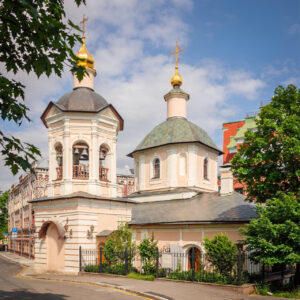
The lower tiers of the old bell tower have survived — decorated in the “Russian-Byzantine” style, with brick patterns. They stand like the stump of a felled tree: the foundation of the bell tower remains, but it is also evidence. From it you can imagine what it was like — tall, four-tiered, with a bulbous dome, visible for many miles.
The Golgotha Hill — an earthwork, not natural — stands to the west of the monastery. If you climb up it, you can see the entire monastery: white walls, domes, a grove that the abbot planted a century and a half ago, Nurma in a new direction, fields. And silence. The same one for which Paul went into the hollow of a linden tree six hundred years ago.
How to get there
The monastery is located in the village of Yunosheskoye, Gryazovets district, Vologda region. From the M-8 highway you need to turn off at the village of Bolshoye Kosikovo and drive about four kilometers along a country road. The road is dirt and can be difficult in spring and fall. You can take a bus or train to Gryazovets, and from there take a taxi. The monastery is open daily from five in the morning to seven in the evening, with a break for lunch.
Charitable FoundationHoly Land
Temples and Monasteries of Russia