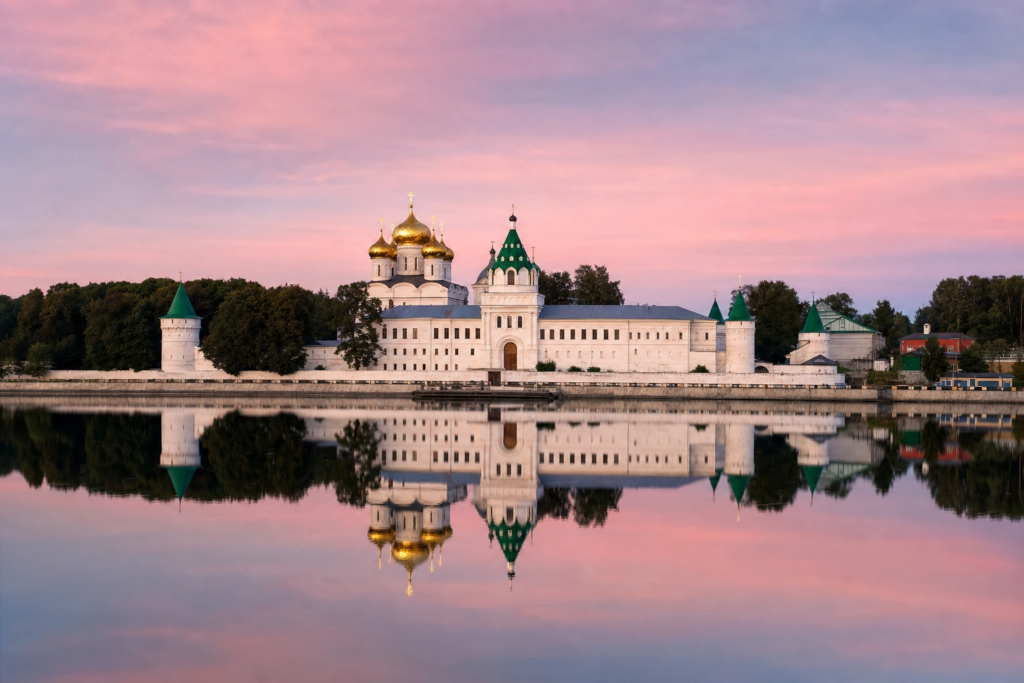
Surprisingly, little is known about the foundation of one of Russia’s most famous monasteries.
Documentary information is not preserved, and where there are no facts, legends reign. The time of foundation varies over the centuries, either in the 13th century it opened, or in the 14th century. And the reasons for the construction of stories go a lot.
Murza of the Golden Horde, Grand Duke or Earrings
Novgorod
One of the stories connects the construction of the monastery with the ancestor of the boyar and then the royal family Godunov. According to oral legends, in the 14th century Murza Chet fled from the Golden Horde to Moscow. He asked for protection and mercy from the Grand Duke Ivan Kalita, converted to Christianity, began to live – to live, but fell ill. And on the journey, exhausted with pain, I suddenly saw the former Murza, and now the boyar Zachary, the Mother of God, the Apostle Philip and the martyr Hypatius. As a result, the boyar recovered, and a monastery was laid at the place of vision. Historians tend to rank this story as a legend, but one thing is known for sure — the Godunov monastery was considered «their» and generously donated to its development. The Godunovs at the monastery had personal tombs, many members of the famous family were buried in them.
There is another version of the foundation, it is associated with Prince Vasily Yaroslavich, the brother of Alexander Nevsky. He loved Kostroma so much that when he became Grand Duke of Vladimir, he did not move to Vladimir, but stayed here. He gave the land and a gift of money.
The third version claims that the monastery was founded by merchants from Novgorod. Saint Hypatius in Russia was little known, but in Novgorod he was revered, considered the patron saint of merchants.
First, a church was built on the site of the confluence of Kostroma into the Volga, and there the inhabitants appeared.
They opened a strange house, began to conduct services and bless travelers.
The first official mention of the Ipatiev monastery dates back to 1432. He was small and rather poor. But when the Godunovs achieved a high position at the royal court, they began to generously donate to the construction and decoration of temples.
The history of another royal family – the Romanovs – is connected with the monastery. Here the young Misha Romanov took refuge during the short reign of False Dmitry II. From here on March 13, 1613 Mikhail Fedorovich was taken on a sled to Moscow — to the kingdom. The Romanovs never forgot about this, showered the monastery with generous donations, loved to visit here. Before the wedding, they came to the kingdom.
Rise and fall
The Polish troops of False Dmitry captured the monastery in 1609, but the militia managed to recapture it. Unfortunately, during the fighting, the fence of the monastery and the Trinity Sobr itself suffered.
During the first Romanov – Mikhail, the New City was added to the old monastery – a vast space surrounded by strong walls with 3 towers. Apparently, Mikhail Fedorovich recalled how he was afraid that the “Tushino thief” would come for him to the monastery – he strengthened it as a real one.
fortress. The towers of the fence had a military purpose. From Water was a secret passage to the river, and Powder kept barrels of gunpowder. That played a fatal role. In 1649, the Powder Tower exploded and destroyed the Trinity Cathedral with its ancient iconostasis. In its place built a new, much larger and richer. The walls of the temple were decorated with magnificent frescoes.
The old part of the monastery was also strengthened, walls were built, holes were eliminated. The tsar sent masters from Moscow for this.
But not all Romanovs treated the Ipatiev monastery with reverence. Tsar Peter ordered the bells to be removed. He needed metal for guns. He also needed money, so that the monks had not only to forget about the rich donations, even the necessary sums were necessary.
Cut. By the middle of the 18th century, the monastery came into complete desolation. But when it became the residence of the bishop, it was rebuilt, renovated. In 1747, the Theological Seminary was opened at the monastery, and in 1764 a new church was built — the Nativity of the Virgin.
In the 19th century, the monastery buildings were restored twice. Both times at the initiative of the tsars – Nicholas I and Alexander II. Again the star of the Ipatiev monastery shone. Alas, not for long.
The revolution has come. By order of the new government, all precious metals were seized. From the monastery took 14 kg of gold and 200 kg of silver. The building was given as a dormitory.
During the war, the authorities softened their attitude towards believers who gave their lives, their work and their savings to the fight against the enemy. The monastery was considered as a monument of history.
After the war, several objects of wooden architecture were transported to the territory and an open-air museum was organized.
The monastery was reopened in 1991. After long disputes over the division of territory between the community and the museum, all the buildings were returned to the Church in 2004.
Shrines
From the famous ancient icons of the monastery, little has been preserved. Fires, explosions, years of oblivion were not in vain. Many icons were taken to Moscow, distributed to various museums.
But in the monastery there are still shrines worthy of worship.
These are the 4 arks keeping:
Particles of God’s robe
The Relics of St. Simon Yuryevetsky
Particles of the relics of Saint Hypatius
Stone from the basement of the house where the imperial family was shot
The main icon of the monastery is the Mother of God Ipatievskaya. She was brought with her boyars, who came to call Mikhail Romanov to the kingdom. The icon was miraculously preserved and returned to the monastery in 2004.
The monastery is open for visits, on the territory there is a museum, a souvenir shop. Pilgrims can take part in worship and worship shrines.
Charitable Foundation Holy Land
Russian Temples and Monasteries