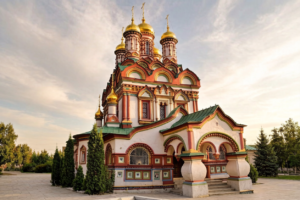
Nizhny Novgorod knows how to surprise. But even among its architectural treasures, the Stroganov Church stands apart — literally and figuratively. White carved walls, five multi-colored domes, a slight tilt of the bell tower over the Volga. You come closer and you understand: this is not just a temple. This is a family history frozen in stone, a royal resentment and a miracle of survival.
Grigory Stroganov built it for his own — not for the city flock, but for his family and associates.
Hence the deliberate care in the details: carved portals, white stone lace around the windows,
columns, as if removed from a piece of jewelry. The church was founded at the end of the 17th century, but a fire destroyed the almost finished buildings. The construction was completed by the merchant’s widow Maria Yakovlevna. When Archbishop Pitirim finally consecrated the temple in 1719, more than twenty years of work were behind him.
But the real drama happened later. Peter I, having visited the church, discovered in the iconostasis the images that he himself ordered from the master Caravaque for the capital’s Peter and Paul Cathedral. Stroganov, seeing the works in the artist’s studio, secretly bought them for his Nizhny Novgorod church,
asking Caravaque to write new ones for the sovereign. The deception was revealed. By personal order of Peter, the temple was closed and did not open until his death. Those same icons are kept here to this day.
Stroganov Baroque is a special phenomenon in Russian architecture. This is not European pomp and
Moscow restraint, but something third: ornamental madness elevated to a system. Five chapters are located according to the cardinal points — this is how wooden churches were built in the north. A two-tiered volume, a refectory without a single column inside, white stone carvings outside and inside.
Divine services, however, from the very beginning were held only on the upper tier — the lower one remained uninhabited.
On the bell tower you can still see ancient slabs with Cyrillic letters: the dial was not divided into twelve, and into seventeen parts — according to the ancient Russian time system.
It was this mechanism, according to legend, that fascinated the young Ivan Kulibin and aroused his interest in watchmaking. Later he repaired it himself.
The Soviet government sentenced the church to demolition. But abbot Sergiy Weisov spent years knocking around the thresholds of bureaucratic offices, carrying archival documents and photographs with him, and giving lectures on the value of Stroganov Baroque. It helped. The building was turned into a museum of atheism, and the priest himself was formally
became its director. During the war, medicines were stored here, and it was the pharmacy warehouse that saved the iconostasis. Of the forty-six icons of the 17th century, forty-three survived.
In June 1993, the temple was consecrated anew. Today it is operational, it contains ancient images and clocks with Kulibin history, and its bell tower still tilts slightly and looks at the Volga, just like three hundred years ago.
Charity FoundationHoly Land
Temples and Monasteries of Russia