A small town with a population of 30 thousand was at one time located on trade routes.
Then life was in full swing, goods flowed through the city beyond the Urals, to the south, to the north, to Arkhangelsk. Ivan the Terrible included Ustyug in the list of oprichnina cities. And where there are people, there are temples. And although since the 18th century trade routes have changed and Ustyug has turned from a wealthy, important transport center into an ordinary provincial town, the churches have remained.
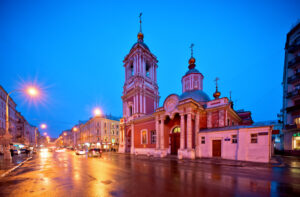
Most of them are used for civil institutions. For example, in the Church of St. Nicholas Gostinsky (Church of St. Nicholas the Wonderworker) there is an ethnographic museum.
The church was named Gostinsky because it was built by “guests” — visiting merchants. When is not known exactly. The first written mention dates back to 1630. Then the church was wooden and in 1679 it burned down. After 3 years, they began to build a stone temple on the ashes. It united the warm church of Dmitry Prilutsky on the first tier and St. Nicholas Summer Church on the second.
At the beginning of the 18th century, the building was again damaged by fire. During the renovation process, it was updated and added to. In 1720, a three-tier bell tower was erected.
Surprisingly, the temple operated until 1930, but was still closed. At one time there was even a camp for transit prisoners on its premises. Then a carpentry workshop was opened there.
In the 80s of the last century, restoration work began to restore the ancient architecture of the building. They ended in 1986. Upon completion, an ethnographic museum was opened in the building.
On July 22, 2023, after 20 years of restoration work, the bell tower was opened. In honor of the city day, the surrounding area was ringing with bells. Inside the premises there is a photo exhibition that tells in detail about the progress of the restoration work.
There are 2 large exhibitions inside the temple. The entire first floor is dedicated to folk crafts of the Ustyug region. Visitors have the opportunity to see examples of the famous northern weaving, forging, carving, and wood painting.
The second floor tells about the significance of holidays, including church holidays, in the life of Ustyug residents. There is the main iconostasis of the Church of Demetrius of Thessalonica, which includes 30 icons. These are unique examples of northern writing from the 17th-18th centuries.
Charity FundHoly Land
Temples and Monasteries of Russia