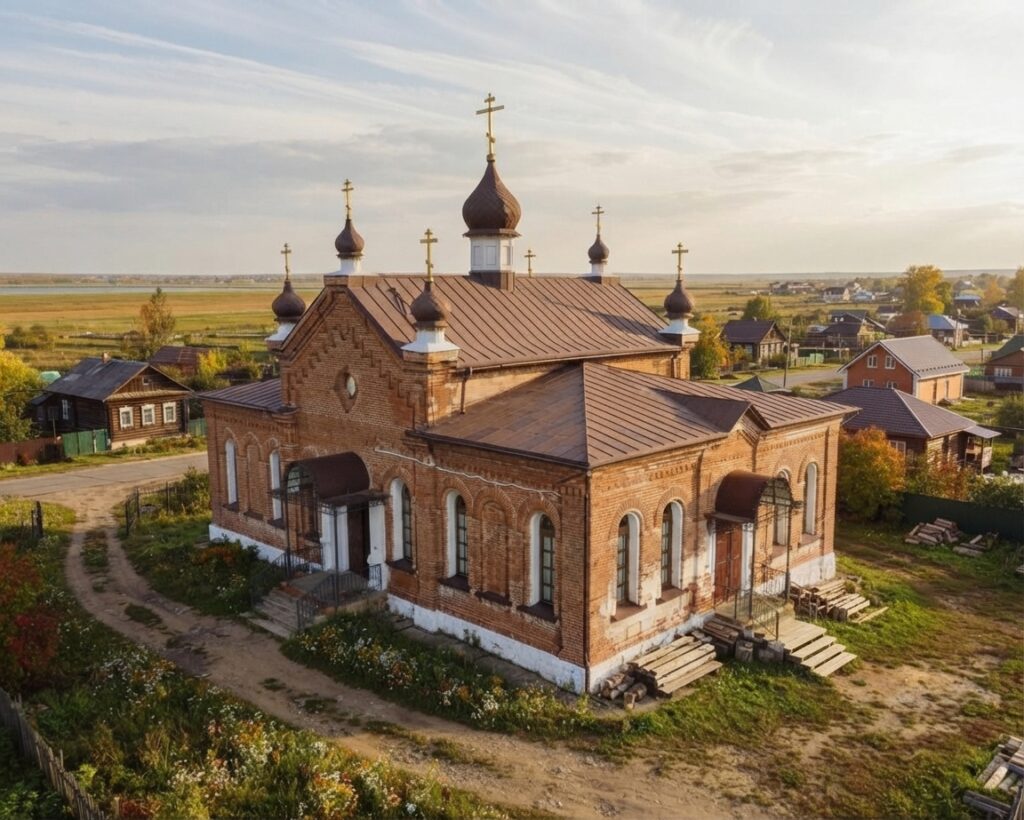
In the village of Gubernskoe, lost among the Ural overflows of the Argayash district, there is a temple that smells not only incense, but also honey gingerbread. Massive, quacky, as if ingrown into the ground, he remembers the times when the village was called Bespalovka, and the road to it was washed away by autumn rains so that not every cart reached. Today people come here for the silence, for the coolness of Lake Uvildy and for an amazing feeling — as if they got into a story that can be touched with their hands.
At the beginning of the XX century, troubles struck Bespalovka one after another. Fire whirlwinds passed through the village, leaving behind a head and despair. But people didn’t give up. Instead of finding out where to go, the peasants and local merchants decided to be a temple here. And not just churches, but churches and schools – to pray to God and teach children literacy. From 1908 to 1912, the whole world collected funds, carried stone, kneaded solution. It turned out a building, within the walls of which the lines from the Psalter and the irregular chorus of student voices sounded equally solemnly.
The architect (his name, alas, has sunk) designed a three-nave basilica with lowered side chapels. No pretentiousness: strict lines, laconic decor. But crowning this brutal simplicity is an unexpected five-headed – five bulbous chapters that seem to hover over a heavy volume. By 1916, the school had grown so large that a separate house was built for it, and the temple was left alone with its main purpose.
However, this idyll did not last long. The thirties grinded the fate of the church into dust. First, the bells were sent to remelting — the front needed metal. Then the icons were dried up, the altar was stabbed. The coils of a film projector twisted in the prayer walls: the temple was turned into a club. And later, they poured grain into the naves. Grain storage is perhaps the most bitter metaphor possible. The building was dilapidated, the roof was leaking, the plaster crumbled, exposing the wounds of brickwork. It seemed like a couple of winters and only a memory will remain of St. George’s Church.
But in 2008, something happened that could not be called a miracle. The temple was returned to the faithful. Empty, gutted, with gaping holes in the dome, he waited his time. The restoration was undertaken not by the monastery treasury or the state budget, but by specific people – the owners of the Teplopribor plant, deputy Konstantin Zakharov. They invested a lot of money, but most importantly — with a soul. The masters of bits restored what was lost. In 2010, the renovated temple was consecrated. Today, Priest Alexander Nevzorov serves here, a man of amazing energy who created a whole social continent at the temple. There is a society of sobriety, and family gatherings, and even «George’s games» for children.
Now, the carrot. Tom himself, «Gubernsky», which weighs more than a pound. Chelyabinsk confectioners decided that such architecture is worthy not only of postcards. According to the ancient technology of the XVIII century carved a gingerbread board — «the banner». Jewelry work: on a linden plaque dried in the shade for several years, the master banner reproduced the facade in all details, from bulbs to window openings. The impression — and now a fragrant souvenir is born, which is stored for months and smells of honey, cinnamon and Ural herbs. They say the hand doesn’t go up to break it. So it stands on the shelf — like a warm greeting from the Governor, where faith, history and craft are intertwined in one tight fragrant knot.
Charity FundHoly Land.
Russian Temples and Monasteries