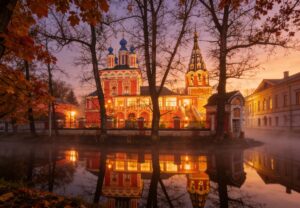
This church is one of the few that was not built as an Orthodox church. The knights of the Teutonic Order laid the building under the church in 1340. By the name of the area, the building became known as the Church of Arnau. The church was dedicated to St. Catherine. In 1370, the building
It was decorated with frescoes on 119 biblical subjects.
Kirch was a place of pilgrimage before the Reformation. Then it became a Lutheran church, the frescoes were painted over, the interior was remade.
Although the frescoes under the whitewash were discovered in the 19th century, they were released from the plastering system only in the early 20th, during the first restoration.
The building was badly damaged during the Patriotic War. After the war, it was not used for its intended purpose. In the 90s of the last century, restoration work began. The money was provided by the German Cultural Society. The funds later came from the federal budget. The main task was to preserve the frescoes. Restorers dug drainage ditches, installed sensors to measure temperature and humidity.
In 2008, a local history museum was opened in the building, but in 2010 it was transferred to the Russian Orthodox Church. A parish was formed, and later, a convent in the name of St. Catherine.
Currently, the temple holds regular services, the Sacrament of Baptism and watershed.
In a small monastery, particles of the relics of many saints are collected: the Great Martyr Barbara, St. Ignatius Bryanchaninov, Seraphim of Sarov, John the Recluse. There are particles of the Tree and the Holy Sepulchre, the robes of the Virgin, stone from Golgotha.
Charitable Foundation Holy Land
Russian Temples and Monasteries