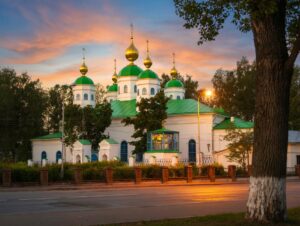
The history of this corner of Astrakhan began not with stone vaults, but with shelter. In the distant XVII century, Metropolitan Sampson, fleeing the “wedding riot”, hid in the Boldin steppe. The secluded place at the confluence of the rivers seemed to him fertile for silence and prayer. Later, the Kazan Soldiers’ Regiment settled here, and then the merchants who settled the settlement. But fate decreed that fire became the main engine of construction.
In the middle of the XIX century, Astrakhan burned often and horribly. The fire of 1858 destroyed the piers and buildings, and almost twenty years later, in 1877, the fire swept through the Kazan settlement, leaving hundreds of families homeless. People rushed to master the undeveloped steppe between the Volga and Bolda. So a new “village” appeared on the city map. The Kazan church, to which the inhabitants were attributed, barely survived — only burned walls remained. It was restored, but the temple was too small for a sprawling parish.
Then the idea of a new church was born. The key role in this was played by the merchant Ivan Ivanovich Gubin, a man of amazing fate. Having experienced a personal tragedy (the death of his only son), he sent all his huge fortune to charity. Gubin lived in a simple wooden house, almost ascetic, but generously donated to hospitals, shelters and temples. Pokrovsky Cathedral became his main offspring. It was he who proposed to name the church in honor of the Intercession of the Virgin, because this icon was considered a protector from fires, so familiar to the residents of the settlement.
The author of the project was architect Pavel Znamensky, a graduate of the Academy of Arts. He created a project in the Old Russian style, where the red brick walls harmoniously combined with white-stone lace casings. Construction took several years, and in 1885 the bell tower was raised. The consecration of the main throne took place on September 29 — on the eve of the feast of the Intercession. The chapels of the temple were consecrated in honor of John the Baptist and the healer Panteleimon. By the way, the choice of the latter is not accidental: at that time the Athos shrine traveled around Russia, and the news of miracles from the icon of the Great Martyr reached the Volga coast.
The Intercession Church was lucky to survive the hardship of the XX century. When the cathedrals were closed and blown up in the country, this temple remained active. However, in 1941 it was briefly turned into a sugar warehouse, but in 1943 it gained a new status — it became a cathedral.
Archbishop Philip (Stavitsky) played a huge role in the revival of the temple in the Soviet years. He survived exiles and arrests, but it was through his efforts that the cathedral regained its greatness. When the bells were dropped in the 1930s, Bishop Philip found a way out: he appealed to believers to donate silver and copper items to cast new ones. Today his grave is under the bush of the temple (left of the altar), and parishioners revere him as the heavenly patron of Astrakhan.
The walls of the cathedral store unique shrines. There is a powerful icon with a particle of the Robe of the Virgin and the Tree of the Cross of the Lord, presented by Archbishop Sergius in 1955. And the image of St. Sergius of Radonezh with a particle of relics was transmitted by Patriarch Alexy I himself.
Today, the Pokrovsky Cathedral is not just the architectural dominant of Astrakhan. This is a living witness to the change of eras, a place where the history of the capital of the Golden Horde, the merchant’s scale and the confessional feat were intertwined in a single pattern. Looking at its soaring bell tower, it is hard to believe that once there was only a scorched steppe around. But, apparently, it is in the wasteland that faith blooms most vividly.
Charity FundHoly Land.
Russian Temples and Monasteries