The history of the Assumption Cathedral, as well as the city of Smolensk itself, is full of amazing events. Some of them are tragic, but there is also a lot that makes the heart fill with pride, excitement and joy.
The first cathedral was organized under Vladimir Monomakh, who reigned in Smolensk. Built in 1101, for a long time it was the only stone church in the city.
From his mother, a Byzantine princess, he inherited the icon of the Mother of God Hodegetria (Guide). The prince handed it over to the cathedral, and from then on the icon was called Smolensk. Many miracles were associated with her, but one of them was special. When Batu’s hordes approached Smolensk, they did not immediately attack the city, but stopped nearby, gathering forces. The residents understood that they themselves would not repel the raid. The entire city spent time in fasting and prayer, asking the Intercessor to protect them from the Tatar-Mongols. One night, the sexton had a vision of one of the city’s defenders, Mercury, coming to the icon. When the warrior fell to his knees in front of the icon, the Mother of God ordered him to go to the enemy camp and fight the enemy alone. Knowing that a martyrdom
death awaited him, Mercury did not hesitate for a moment. He penetrated the camp and defeated many enemies until he himself was killed. This forced the commanders to abandon the assault on Smolensk. And the remains of Mercury were buried with honor in the cathedral.
Unfortunately, the icon was lost during the Great Patriotic War. Now in the cathedral there is a copy of it, made in the 17th century, called “The Gateway”. This icon was with the Russian troops during the battles for Smolensk in 1812.

The first stone cathedral of Smolensk was badly damaged during the intervention of the Polish-Lithuanian Commonwealth in the 17th century. In 1611, during an explosion near the cathedral hill, part of the cathedral collapsed. The women and children hiding there died.
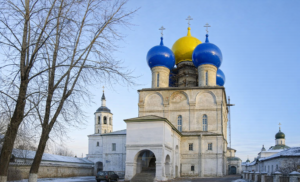
After Smolensk returned to Russia, the old cathedral was dismantled. In 1677, they began to build a new one, but the work was suspended and completed only in 1740. The cathedral was decorated in the Baroque style, and its 7 domes were covered with sky blue.
After the revolution, the cathedral was not closed completely, but part of it was allocated for worship, and part — for the museum of atheism.
During the war, it suffered no damage strongly, continuing to operate to this day.
Shrines
- Icon of the Mother of God “Gateway”
Copy from the ancient “Hodegetria” - Shroud
Woven in the 16th century for Moscow temple, but was recaptured from the French in the territory
Smolensk region. Therefore, the decision was made to store it there. - Sandals of Saint Mercury
Initially, the temple had all the warrior’s vestments, but over time, parts of it were lost.
The French took the spear with them, and in 1954 the helmet disappeared. Now only
sandals remain in the temple. - Icon of St. Abraham of Smolensk
Charitable Foundation Holy Land
Temples and Monasteries of Russia