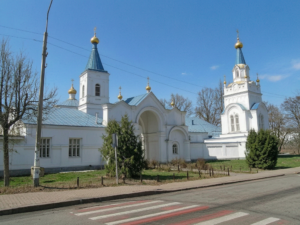
From time immemorial, the Russian land was kept on companions and enthusiasts. Despite all the difficulties, they achieved their goal. That is exactly what happened with the history of the Cathedral of Archistratig Michael.
After the end of the Russo-Turkish War in 1864, Russia began active colonization of the Black Sea territories. The idea of developing new lands caught fire Moscow agronomist Peter Vereshchagin. He called on the people to move to new lands through newspapers, he considered it an important step for Russia.
When the question arose about the construction of a church for immigrants, Pyotr Vasilyevich organized a partnership, began to seek funding. It’s a shame his health failed him. The wetlands were full of mosquitoes. Vereshchagin became ill with malaria and could no longer pay attention to cases. But the idea of building the cathedral was supported by his brother, Arseny.
He moved to Sochi and began to arrange new lands. Arseniy Vasilyevich found a sponsor, a rich merchant Mamontov, invested his money, hired the architect Kaminsky.
On May 26, 1874, the first stone was laid at the foundation of the cathedral. Alas, the construction took a while.
Large-scale construction on new, undeveloped lands was not easy. Supplies were regularly disrupted, there were not enough workers. And then there’s the Turks. Likely and far from the building were fighting, but here you go — flew a random core, stuck in the wall. After the war there was a catastrophic shortage of funds. Arseniy Vasilyevich worked on the construction of the temple along with the workers, tried to organize the Committee for Assistance. Finally, the Synod took over the construction and in 1891 the temple was consecrated. I must say that the building of the cathedral complex was not limited, it included a bell tower, church house, refectory, wells, cellar. At the cathedral, a library and an archive were organized. They recorded and preserved the history of the city. Later, a parish school was opened, and a nursery for plants was laid on the territory. This is how the church quarter was formed.
The church was built on the classical model — in the form of a cross. Decorated with arches and vaults. The gilded head was visible from afar. The Cathedral of Archistratig Michael became the centers of spiritual and cultural life of the residents of the new city.
Unfortunately, the wind, or rather the hurricane, did not bypass the cathedral under the Soviet regime.
First, the bell ringing was banned. Then they decided to destroy the temple.
It survived only because it was adapted for a granary. A parishioner who worked for the Committee secretly put the building on the lists. The building was defended, but the cross was removed from it and the tent was destroyed.
The war affected the attitude of the state towards the church. The leadership of the church supported the liberation struggle, and the faithful gave their lives, labor and savings to the front.
In 1943, worship in the cathedral resumed. The parishioners immediately began to rebuild the church. Even before the end of the war, the cathedral again had a tent and a cross.
And in 1981, the temple was recognized as an architectural monument and put under state protection. As a result of the restoration of 1992-1994, the cathedral returned its original appearance. Sochi architect Fedor Afuksenidi restored it according to the original drawings. In 1996, the baptism church of the Iverian Icon of the Mother of God was built on the territory.
In the new century the temple was reconstructed. Replaced the roof, carried out heating. Updated communications. Ennobled the area. They built a water chapel.
In 2010, the interior of the temple was updated.
The white temple with golden heads is perfectly visible from the sea. It is buried in greenery, famous for its cypress alley.
At the temple there is a Sunday school, library, children’s choir.
Charitable Foundation Holy Land
Russian Temples and Monasteries