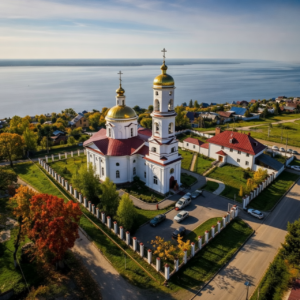
The locals called the ravine. When in 1701, the temple of St. George the Victorious was built, he was behind a ravine, local «behind the top.» They built a church on the site of an old, wooden one. If the design is made in the style of Russian Baroque, then the temple itself is a classic four-piece. The building is two-story, with a tent bell tower. There were 7 bells on it. In the middle of the 18th century, the temple was updated, then the upper temple was painted. The frescoes have been updated repeatedly. The lower temple was painted only in the 20th century. The galleries were glazed after the Great Domestic.

The service in the cathedral was practically not interrupted, it was closed in 1940 for a very short time. In the 50s and 80s, the building was renovated. Cleaned frescoes from perennial layers, strengthened the dome.
By the millennium of the baptism of Russia, new paintings appeared in the temple, all the icons were restored. The building was painted, the roof was closed and a new cross was installed.
The cathedral was considered a cathedral from 1926 to 1999, but then this status was transferred to Troitsky, and Georgievsky became just a cathedral.

Shrines
From the day of consecration, pilgrims sought to worship its main treasure: the icon of the Kaluga Mother of God. With the patroness of the city and all the sick make the procession 4 times a year.
There are other icons worthy of worship: Saints Nicholas, George, Paraskeva Friday, the Savior. Two icons of the Mother of God: Jerusalem and “Satisfy my sorrows.”
Divine services are celebrated in the morning and evening, on Sundays there are 2 Liturgies. Communion takes place every day during the morning service.
Charitable Foundation Holy Land
Temples and Monasteries of Russia