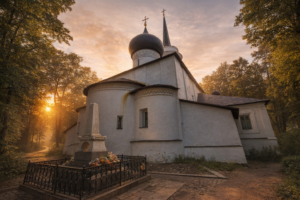
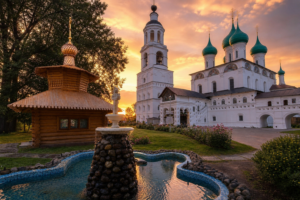
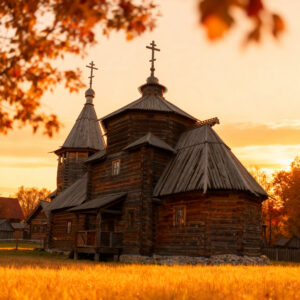
The beautiful white stone cathedral now serves as the hallmark of the city. But his fate was not easy and the fact that he survived at all is a miracle, no less.
The building of the cathedral can not be called ancient — it began to be built in the late 19th century. The occasion was the celebration of the 900th anniversary of the baptism of Russia. But while the place was allocated, the contest was announced, time passed. The competition was won by the project of engineers from St. Petersburg N. Ikavits and V. Kosyakov.
A special place was chosen – on the border of the Muslim and Orthodox quarters. The purpose of the construction was not only to mark the baptism of Russia, but also to attract Muslim Astrakhan to Orthodoxy.
The temple was built slowly — there was not enough donations. And natural disasters have affected. First crop failure, then cholera epidemic. Construction work was completed only in 1902. And again guessed for the anniversary — 300 years of Astrakhan province.
Despite the fact that the architects were from St. Petersburg, they gave the cathedral a classic Byzantine look. Externally, the temple resembles the first Christian basilicas, with narrow high windows, many columns, stone carvings. The temple of the dome was especially distinguished, not bulbous, as was customary in Russia, but helmet-shaped, as was built in Byzantium.

Little is known about the interior of the temple and how it worked. But after the revolution, the activities of the cathedral were active and left a documentary trail. This is due to the renewal movement.
Since 1917, Patriarch Tikhon was under house arrest. This was taken advantage of by a group of church officials. They recognized Soviet power and began to work closely with it. By 1922, the Renovationist movement was approved by 37 bishops, 34 were against, and 24 did not express their attitude. The authorities strongly supported the renovationists until the mid-30s. As a result, there was a split in the church. “Tikhonists” advocated the preservation of the canonical Church, “renovators” welcomed the reforms. But by the mid-30s, the country’s leadership declared terror against religion and ceased to distinguish between the currents in the Russian Orthodox Church. Without the support of the authorities, the Renewal movement came to naught and by the end of the Great Patriotic War disappeared.
The parishioners of Vladimir Cathedral from the very beginning stood for the canonical church. When a follower of the Renovationists tried to conduct services there, the believers did not let him into the temple. Of all the cathedrals of Astrakhan, only Vladimir was faithful to the canons of the church. Therefore, in 1924, Bishop Thaddeus of Astrakhan moved his see there. The cathedral became a cathedral.

However, by 1936, the resistance of the parishioners was broken and the cathedral was still in the power of the renovationists. And after 3 years it was completely closed. The authorities decided that the city needed a warehouse more than a temple.
After the war, in the mid-60s, the building was converted into a bus station. The interior painting was whitewashed, a second floor was created under the dome.
In 1999, the building was transferred to the church. Outside, repairs were carried out and the cathedral acquired a modern look. The interior decoration of the temple was very slow. It remained unpainted and there were few utensils. The situation changed in 2020, when the restoration of the cathedral was allocated money from the federal budget. The work is far from complete, but the temple works. There is a Sunday school and a library.
Charitable Foundation Holy Land
Russian Temples and Monasteries