On the steep bank of the Valui River stands a giant temple. Its five domes pierce clouds at a height of fifty-five meters, and the walls remember both the royal grandeur and the hum of prison looms. Every brick of this cathedral is saturated with a story similar to the parable of the fall and resurrection.
How did it all start? Legend. They say that at the end of the XVI century, the icon of Nicholas the Wonderworker appeared on this place. She was carried three times to the city temple, but by morning the image invariably returned. The stubbornness of the shrine was regarded as a sign, and the monastery grew here. And in 1613, the young Tsar Mikhail Fedorovich granted the monastery official status.
The main temple was built three centuries later. The case was entrusted to Archimandrite Ignatius. Brick was taken from his own monastery factory, which was nearby. Construction was in full swing for seven years and ended with a grand celebration in the autumn of 1913. Fifty thousand people gathered for consecration. Inside everything sparkled: Moscow icons, faience iconostasis, gilded domes. Three thrones bore the names of royal persons and patron saints of the Romanov dynasty.
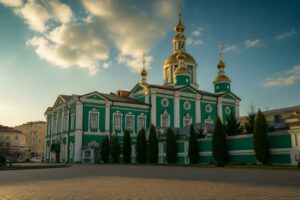
The architecture is still striking today. Imagine a four-pillar quadruple lined with red brick. The length is thirty-seven and a half meters, the width is thirty-two. The foundation goes deep almost five meters. The facades used to be decorated with plaster figures of saints, covered with brown paint under stone. Now only archival photos remind of the former decor.
The Soviet years have become a black stripe. First, the closing in the twenties. Then there’s a juvenile delinquent colony. The shrine was turned into a casting, vegetables were stored in the basements. Heads were dropped, crosses were destroyed, walls were mutilated with extensions. The giant stood dilapidated, waiting for change.
And they came. In 2009, work boiled over. Brigades of builders cleaned the basements, strengthened the structures, re-erected the vaults. Two years later, Archbishop John of Belgorod consecrated the four-throne church. The lower tier was dedicated to All the saints who shone in the Russian land.
Today St. Nicholas Cathedral is again full of life. Its bell rings over Valuy, and on Sunday services hundreds of believers gather. Looking at this mighty silhouette, it is hard to believe that even a quarter of a century ago the wind walked here and the masonry crumbled.
Charity FundHoly Land.
Russian Temples and Monasteries