Yoshkar-Ola is a young city by the standards of Russian capitals, but it has its own history. The Ascension Cathedral stands here longer than the current name of the city itself. When this place was still called Tsarevokokshaisky, the merchant Ivan Pchelin had already ordered the laying of the first stone — it was 1756, Elizabeth Petrovna sat on the throne, and the provincial merchant decided to leave behind something more than barns with goods.
Bechelin put the church next to his own house — almost close to the fence. This was not an accidental gesture: so did the merchants who wanted to see their good deeds out of the window every morning. We don’t know what he was thinking when he looked at the octagonal dome. But there was something to watch.
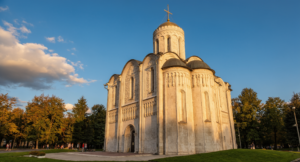
Architects — their names history has not preserved — brought to the city the handwriting of the Vyatka-Perm school. This is felt in carved casings: not strict, not ceremonial, but almost playful — garlands, columns with interceptions, lace of white stone on brick walls. Baroque here is not metropolitan, pompous, but provincial — warm, a little naive and therefore especially charming.
Inside was a relic, which was spoken in low voice. A tiny stone — a little larger than a postage stamp — with two carved images: on the one hand — Nicholas the Wonderworker, on the other — George the Victorious. The icon was found far from here, in the Yaran county, and Pchelin brought it “for a time.” This time stretched for a century and a half.
Then came the XX century, and the cathedral began to be persecuted, as if revenge for its longevity. Closing, humiliation due to the change of owners: radio committee, beer warehouse, factory shop. The bell tower was dismantled. The gallery was demolished. The painting was destroyed. To the refectory, like a foreign growth, a sullen factory building grew.
However, the walls were stronger than the plans. In 1992, the building returned to the faithful, and the Easter service of 1995 was held under vaults that remembered the Catherine era. The bell tower was rebuilt — in 2008-2009 it took its place, as if it had not been touched.
Ascension Cathedral does not give the impression of a ceremonial object. He’s more like a man who’s been through a lot, a little shabby, but with dignity. And that’s what makes him truly alive.
Charity FundHoly Land.
Russian Temples and Monasteries