In Astrakhan there is a place where time seems to be layered on top of each other — every century has left its mark here, and not always gentle. The Annunciation Convent at the intersection of Sovetskaya and Kalinin streets is almost four hundred years old. It burned, collapsed, turned into barracks and children’s colonies — and still survived.
It all started back in the 17th century, when two small women’s communities existed in Astrakhan
— Blagoveshchenskaya and Pyatnitskaya. Both were small in number and huddled in wooden buildings. At the beginning of the 18th century they were united and transferred to the buildings of the abolished Voznesensky Men’s Hall
monastery — the oldest church building outside the Kremlin. The men’s monastery was poor:
the construction of the stone cathedral church took more than half a century, there was always a shortage of funds, and
hegumen Gerasim died without completing what he started. When the monastery was finally consecrated, its age was already
was coming to an end.
Together with the nuns, its main shrine also came to the new monastery. In 1671, Voivode Ivan
Miloslavsky entered riot-stricken Astrakhan, carrying in front of him the icon of the Mother of God
«Life-giving spring.» According to legend, the townspeople fell on their knees before the image, asking for forgiveness for their apostasy. The icon remained in the city, and half a century later it was transferred to the monastery along with the small wooden Church of St. John the Theologian. Later, a stone chapel with an ancient image of St. Nicholas the Wonderworker appeared nearby. The monastery well, the water from which was considered healing, was always crowded.
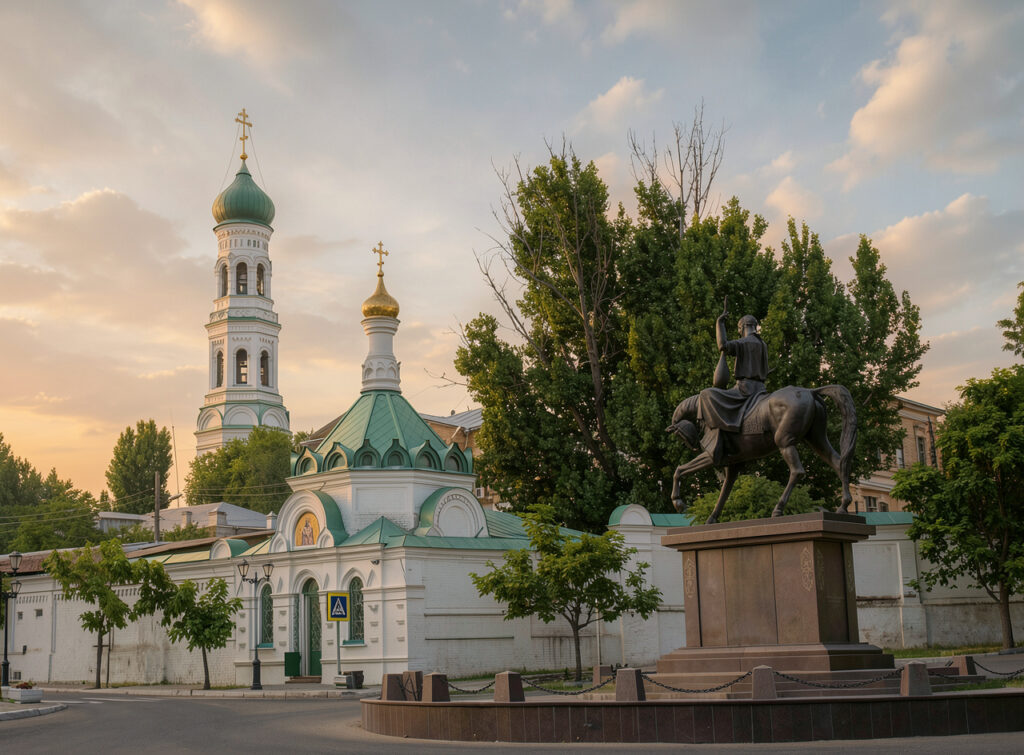
By the beginning of the 20th century, the monastery looked decent: two churches, cells, a school, and a rector’s house. In 1907, a three-tier bell tower in the ancient Russian style rose above the main gate — with the money of local merchants, who spent much more than was included in the estimate. Under the dome, in gold letters, was written: “Blessed is he who comes in the name of the Lord.” The bell tower stood for just over twenty years.
In 1918, Red Army soldiers entered the monastery. Then there was a hospital, a children’s colony,
military registration and enlistment office. The nuns were evicted, the churches were closed, and in 1930 the bell tower and churches were demolished, and the bricks were used for the needs of the new era. Little remains of the once harmonious ensemble: fragments of walls, towers and the chapel of St. Nicholas the Wonderworker.
The revival began in 2008. The walls and towers were put in order, the chapel was opened for
believers. The bell tower was restored according to old drawings and surviving photographs — right down to
the smallest details of the brick pattern. Today it again rises above the main entrance, and the cross on its dome is visible from afar.
The Annunciation Monastery is not just an architectural monument. This is a place that Astrakhan
lost several times and found again each time.
Charity FoundationHoly Land
Temples and Monasteries of Russia