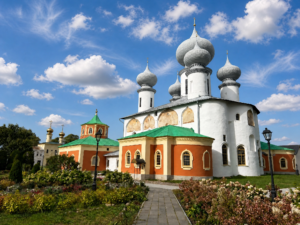
The silence over the Great Lake is such that it seems to hear the waters of the river Pry meet with him near the overgrown island. Here, on a piece of land, once donated by the landlord Shcherbinina, and after bought by the peasant Barkasov, an amazing heart beats — the Alexandro-Mariinsky monastery. His story began not with a decree, but with a miracle that thundered over the entire empire.
In the autumn of 1888, an imperial train collapsed near the Borki station. The family of Alexander III survived literally under a pile of twisted metal. The news of this miraculous salvation stirred up the Ryazan land. Three months later, the widow Maria Yakovlevna Popova decides to take a step that turned private piety into a monastery. She submits a petition for the opening of the community — so, on the wave of popular gratitude, and this solitary place was born, in the name of which the names of the emperor and his wife Maria Feodorovna were forever combined.
The wooden house with the refectory church quickly became cramped for the community, and in 1895 the stone heart of the monastery was laid here. The main driving force of construction was Mother Raphael — the first abbess, whose labors over the lake rose five-domed temple. The walls grew slowly, as if absorbing the surrounding peace. By 1903, when the thrones were consecrated in the name of the Exaltation, the icon of the Sign and Saints Peter and Mary, the monastery was already called a monastery. The new stage is associated with the abbess Valentina. With her, the breath of the monastery went beyond the island: a farmstead appeared in the village of Savior-Klepiki, and in 1911 the ringing of bells flew from a new four-tiered bell tower, announcing the strength of spirit to the district.
But the loudest in this story was the three-hundred-two-two-two-type bell. It was donated by the legendary Elder Barnabas of the Gethsemane hermitage – the one who was called the comforter of the suffering and who predicted the glory of the future philosopher Vasily Rozanov. The voice of this giant must have been special, with a deep, floating octave above the water.
The twentieth century mercilessly walked the island. In 1918, the monastery was closed, the belfry was silenced. Later, the pioneers of the Sineva camp ran through the holy rooms, and in the silence of the altars a radio from the Izvestia rest house sounded. But through decades of oblivion, the main thing survived — the temple, the monastery gates and the abbess’ house. Like three silent witnesses, they waited for the return of prayer. This happened in 1997, when the parish was formed, but the true revival began only recently — in September 2021, the buildings were officially transferred to the Church.
Today, the bell rings again over the waters of the Great. Although not as powerful as under Elder Barnabas, it is as pure. And it seems that through the reconstructed forests and fresh plaster, the very face of Russian holiness appears – quiet, hardworking and ineradicable, like grass breaking through the stones of forgotten foundations.
Charity FundHoly Land.
Russian Temples and Monasteries