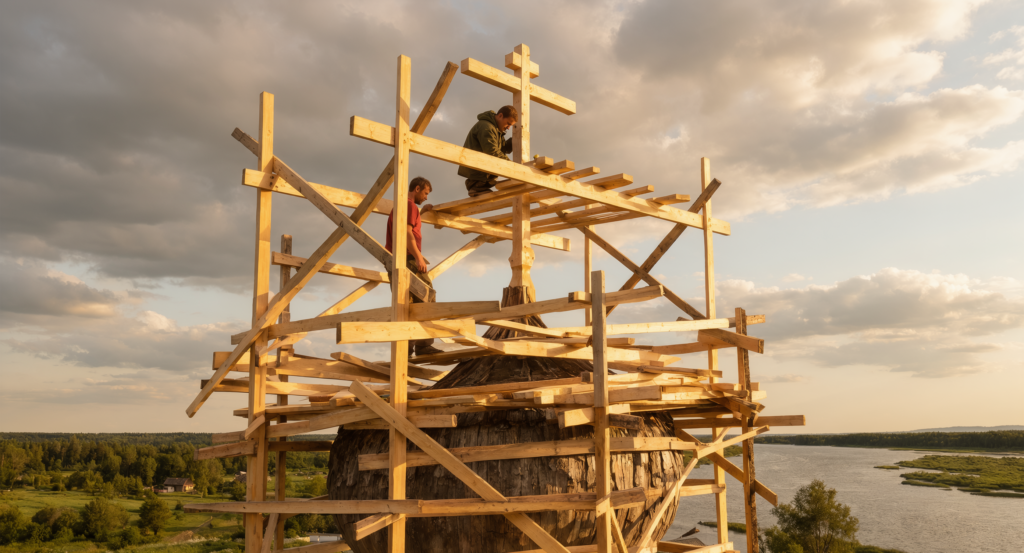
Mikhail Kostikov takes summer vacation for several years in a row, but instead of going to the seaside, he goes to a place that is not the most convenient for relaxation — to the Russian North. To remote villages where there are practically no people. There, together with a team of like-minded people from the “Common Cause” project, he is restoring ancient wooden churches. Why build churches without permanent parishioners and priests, and how did the head of the sales department become the commander of these expeditions? Here is his story.
At first, I didn’t have any luck with traveling to the North with “Common Cause”. I put it off, postponed it, but in 2018 I realized that it was either now or never. I just got a new job and immediately asked to go on vacation at my own expense — it seems that my manager was amazed at such impudence, but when he found out the purpose of the trip, he let me go. In “normal life” I manage sales for a company that provides meteorological services to various enterprises in the petrochemical or food industries. My colleagues and friends, when they find out what I do in my free time, are very surprised, but they always have a positive attitude.
In total, I had six expeditions, but the first one is most memorable. I didn’t know how to work with wood at all then, and in general I had a hard time imagining what the expedition would look like. Of course, I had already seen pictures from previous trips on Instagram, but when I went myself, I was overwhelmed with emotions.
First of all, I was surprised by the nature of the North — it turned out to be very close to me. And, of course, the temple itself, which we came to repair, is more than thirty meters high, amazingly beautiful, but already in very poor condition. The composition of that expedition was very different — this is generally very typical for the project. Among us were an Austrian who works in Russia, students, housewives — in a word, everyone. This is probably why one of the most powerful impressions is communicating with like-minded people who are also so different from each other. By the way, you don’t have to be a believer to join the expedition.
As I already said, on my first trip I didn’t know how to work with wood, I had some very primitive skills. Therefore, I immediately found myself under the guidance of an experienced restoration carpenter, with whom we worked a lot. I cannot express in words all the emotions that befell me there. I didn’t want to leave. Since then, I have regularly participated in expeditions, and recently became a detachment commander. My responsibilities include organizing the trip: everyone must be fed, warm, the planned work must be completed on time.
After my first expedition, I realized that I needed to improve my woodworking skills if I wanted to be effective on future trips. I already knew that there was a carpentry school at the Church of St. Seraphim of Sarov in Raevo, and first I studied there, and later I went to Kizhi to the restoration center and received additional knowledge there. This helped me a lot in my further work — in the construction of old wooden buildings, tools and technologies were used that, for the most part, are no longer used anywhere else. Without understanding these nuances, it is impossible to do serious work in the North.
Why do I need the North and its temples? It seems to me that sooner or later any person asks the question: what is he doing and why. So one day I realized that I was not living quite right, that I needed to change somehow, to do something not for myself. Just then my conscious church life began and I became acquainted with the “Common Cause”. I wanted to spend my vacation not just lying on the sofa or in a chaise longue, but to do something useful.
And more. I have a small son — I want him to know, in addition to consumption, that there is also creation. We have a rich history, heritage, a huge number of monuments, including wooden architecture in the Russian North. I want my son to see these monuments — they are being destroyed quite quickly. I would also like him to understand from an early age that his free time can be spent in different ways — and it does not have to be passive recreation. Therefore, on the second trip I took my son — then he was 6 years old — with me. Since then we have been going on expeditions together. Every time he returns from a trip, he immediately begins to wonder when the next one will be. I’m very happy about this.
Someone may ask: why restore temples that stand in the middle of nowhere? It seems to me that the restoration of old churches and the construction of new ones are not mutually exclusive. Both are important. The churches we go to are, as a rule, in places where people no longer live. No one looks after the buildings, and they gradually — and most often quickly — collapse. A little more and we could lose these absolutely amazing temples. There are especially many of them in the Russian North. If you do nothing now, in 20 years there will be nothing left at all.
The last expedition was to the village of Mondino, Arkhangelsk region. It is located on an island formed by two branches of the Onega River. This village, like many villages in the North, is virtually uninhabited. There is only one person who spends a significant part of the year there and leaves for the winter. He and his family looked after the temple where we came to work for many years. This is the Church of the Life-Giving Trinity, built in 1888. We strengthened the rafters, the refectory part of the temple, covered the roof, and laid subfloors. Since the 1940s of the 20th century, the temple was closed and did not function. And finally, on this trip we were able to hold the Divine Liturgy — what the temple was built for.
It is difficult for me to name any unusual cases associated with the expeditions. By and large, the fact that such dissimilar people of different religions and beliefs, leaving everything behind, go to restore churches in the wilderness is in itself amazing. From the outside, our life in the detachment looks everyday: we woke up, prayed, ate, worked, talked in the evening, sang. But the atmosphere itself is unusual. The way people communicate with each other, try to help each other. Often you don’t even have to ask anyone — people themselves come up and help. As a rule, I don’t see this in my usual city life. This is exactly what I wanted to show my son when I took him with me for the first time.
I go on expeditions two weeks a year. And the return from these 14 days is many times greater than the return from some such everyday activities. Yes, these things are also important, but they do not always bring satisfaction. At least on expeditions I understand for sure that my activities are useful for others. That it makes sense.
Author: Mikhail KOSTIKOV
Saint Charitable Foundation Earth
Investment in the Soul!