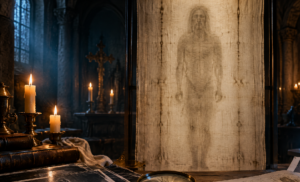
Linen cloth is a little over four meters long and a little more than a meter wide. Pale yellow hue, simple zigzag weave of threads — three to one. This technique was in use in the first centuries of our era in Western Asia. On the fabric there are two full-length imprints of a human body: one from the side of the face, the other from the side of the back. The heads are touching, which means that the cloth was covered from the top of the head to the feet.
Who does this body belong to? The man is about one hundred and eighty centimeters tall, aged from thirty to forty-five. This is what a medical and anatomical analysis showed.
All this became known relatively recently. Until 1898, the shroud was perceived as a revered relic, but nothing more. Change began when the lawyer Secondo Pia received permission from King Umberto I to photograph the painting. While developing the plates in the dark, he suddenly saw a clear positive image of a face emerge from the negative. It turned out that the print on the fabric was a negative. To see the real face, you need to make a negative from a negative.
This discovery has baffled skeptics. The concept of a negative image appeared only with the invention of photography — in the 19th century. How could a medieval artist create a negative on fabric, and even with impeccable anatomical accuracy? In the Middle Ages, dissections were prohibited; scientific anatomy had not yet been born. How would a forger know the structure of the human body better than scientists centuries later?
French biologist Paul Vignon and Professor Yves Delage came to the conclusion back in 1902: the image is anatomically flawless. Further research only confirmed this.
The nails were pierced not in the palms, but in the wrists. Not a single medieval master would deviate from the icon-painting tradition, where wounds are always on the palms. But the palms would not have been able to withstand the weight of the body — this was proven by the surgeon Pierre Barbet only in the 20th century, by suspending weights from the amputated arm. Barbe explained why the thumbs are not visible on the print: a nail in the wrist ruptures the tendon, and the finger goes under the palm. The medieval forger could not have known what science discovered five hundred years later.
On the head there are traces of a crown of thorns. But not in the form of a hoop, as is customary in iconography. The wounds are located all over the head: thirteen on the forehead, twenty on the crown. The crown looked like a hat — this was the uniform worn by eastern kings. The soldiers, mocking the Condemned One, put a royal crown on Him and beat Him on the head with a cane, driving the thorns deeper.
The back, lower back, legs — everything is covered with traces of scourging. Ninety-eight lashes. In the center of each blow, the wound is darker, at the edges it is lighter — there the ichor oozed longer, because the wounds were irritated by the tissue and dried slowly. The heart area is left untouched — blows there are fatal.
The blood on the shroud is real, not painted. In 1981, scientists established: human, group four. There is no image under the drops of blood, which means that the blood lay on the fabric before the print itself appeared.
In the area of the eyes there are prints of coins. An ancient Jewish funeral custom: coins were placed over the eyes to prevent the eyelids from opening. Researchers have identified them as copper mites of Pontius Pilate. On one you can read the letters that form the inscription “Tiberius Caesar.”
In 1973, pollen samples were collected from the surface of the canvas. Fifty-eight plant species were found. Most are Middle Eastern, thirteen are desert and salt-loving, growing only in Southern Palestine and near the Dead Sea. Pollen could not have gotten there in Europe.
But in 1988, three laboratories — Oxford, Arizona, Zurich — carried out radiocarbon analysis and dated the fabric to the 13th-14th centuries. The skeptics rejoiced. However, supporters of the antiquity of the relic pointed to an unaccounted factor: the shroud burned repeatedly (fires of 1201, 1349, 1532, 1934), it was boiled in oil, washed, rubbed, and cleaned with solvents. Contamination with younger carbon could have significantly skewed the results. The radiocarbon method is reliable only when the composition of the sample has not been damaged over centuries of storage — and here it was violated many times.
In 2011, Italian researchers from ENEA, after five years of work, stated bluntly: it is impossible to reproduce the image in the laboratory. It has unique physical and chemical characteristics that cannot be copied. Scientists have calculated that to instantly dye the surface of linen fabric corresponding to the body of an average-sized person, ultraviolet radiation with a power of about thirty-four billion watts would be required. No existing source of such radiation is capable of producing such radiation.
There are no signs of decomposition on the fabric. The body was in the shroud for about two days — then it disappeared without damaging the print. This coincides with the Gospel story: after the death of the cross, Christ was wrapped in a funeral shroud, and on the third day he was resurrected.
In 1997, an exact copy of the shroud was transferred to the Moscow Sretensky Monastery. Patriarch Alexy II consecrated it as the Image of the Savior Not Made by Hands.
The Shroud does not prove faith — it cannot replace living spiritual experience. But it makes you think. For more than a hundred years of research, not a single version of a fake has stood up to scrutiny. No master could repeat what is captured on this canvas. And perhaps this is precisely the main argument: the more science peers into the shroud, the less it can explain.
Charity fond Holy Land
Investment in the Soul!